"Bundle and save" is the most repeated line in insurance advertising, and it's often true — but not automatically. A bundle is simply a multi-policy discount an insurer offers when you hold two or more lines with them. The discount is real; the savings are only real if the underlying policies are competitively priced. A 20% bundle discount on an overpriced home policy can still cost more than two separate, fairly priced policies.
Price Each Line Before You Bundle
Know the standalone cost of home and auto so the "bundle savings" is measurable, not assumed.
Open the Home & Renters Calculator →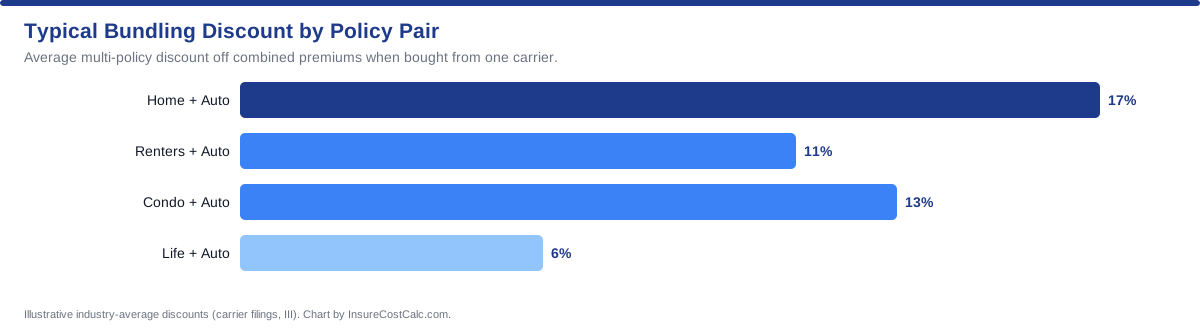
How the Multi-Policy Discount Works
When home and auto sit with one carrier, that carrier keeps more of your business and rewards it with a discount on one or both lines — commonly 10%–25% on the bundled policies. Some insurers also layer in a single deductible or account credit. The discount percentage is easy to see on the quote; the question is whether the base rates before the discount are any good.
When Bundling Clearly Pays
A bundle tends to win when one insurer is genuinely competitive on both lines. That happens more often than not with large national carriers that price both well. Bundling also reduces administrative friction — one account, one renewal date, one app — and can unlock extras like a single deductible if both your car and home are hit by the same event. For many households, the convenience alone is worth a modest discount.
The Hidden Trap: The Masked Policy
Here's where bundles bite. Suppose Insurer X quotes your auto at $900 (fair) and your home at $1,600 (high), then applies a 20% bundle discount to bring the home to $1,280. The bundle "saves" you money versus X's unbundled price — but a standalone specialist might charge $1,100 for the home. You feel like you saved while quietly overpaying. Always get a standalone quote for each line from at least one other carrier before trusting the bundle number.
A Comparison Table
| Scenario | Home | Auto | Total |
|---|---|---|---|
| Standalone A + B | $1,100 | $950 | $2,050 |
| Bundle (disc. on both) | $1,280 | $760 | $2,040 |
| Best standalone | $1,100 | $760 | $1,860 |
In this illustrative example, the bundle ($2,040) beats mixing two standalone carriers ($2,050) by a hair — but buying the cheaper standalone for each line ($1,860) beats both. The bundle only "wins" because the comparison was incomplete.
When to Skip the Bundle
- One line is dramatically cheaper elsewhere — the bundle discount can't always close a big gap.
- You have a specialty risk (high-value home, classic car, coastal flood) better served by a specialist.
- A claim on one line spiked your rate — keeping them separate can prevent the surcharge from spreading.
How Insurers Calculate the Bundle Discount
The multi-policy discount isn't magic - it reflects the carrier's lower cost of acquiring and retaining you as a customer. Acquiring a second policy from an existing customer costs far less than marketing to a stranger, and bundled customers churn less, which is valuable to the insurer. Discounts commonly range 10% to 25% on the bundled lines, and they often extend beyond home and auto: renters, condo, and umbrella policies frequently qualify too. Some carriers add a small "account credit" or waive a fee. The point isn't to distrust the discount but to confirm the pre-discount base rates are competitive - the discount is applied to whatever those rates are.
The Loyalty Trap: What Happens at Renewal
Here's the part advertisers skip. Once your two policies are locked together, the convenience makes you less likely to shop - and some insurers quietly raise the bundled price at renewal, knowing the "hassle" of unbundling deters you. The discount you saw on day one can shrink while the base rate creeps up. The defense is simple: re-quote your bundle against two standalone carriers at every renewal (or at least every two years). If the bundle has drifted uncompetitive, move one line and accept the smaller discount on the other. Never let convenience become a tax on your premium.
Bundling Renters, Condo, and Umbrella
Home and auto are the famous pair, but the same logic applies to other combinations. A renters policy bundled with auto is often the easiest win - renters premiums are cheap, so the discount lands mostly on the larger auto line. Condo (HO-6) policies bundle with auto just like homeowners. And an umbrella liability policy usually requires - and discounts alongside - underlying home and auto coverage, so adding the umbrella to the bundle both broadens protection and sometimes sharpens the multi-policy credit. If you hold three or more lines with one carrier, the cumulative discounts can be meaningful; just verify each line's standalone price remains fair.
A Real-World Example: The $600 "Savings" That Cost $2,000
Consider a household that bundled and saw the home premium drop $600 versus the insurer's own unbundled quote. Feels like a win - until they'd have paid $2,600 for that home policy with a specialist carrier versus the $2,400 bundle price (after discount). The "savings" was measured against an inflated internal baseline, not the real market. Two years later the renewal rose 18%, erasing the discount entirely. The lesson isn't "never bundle" - it's "benchmark the bundle against the cheapest standalone combination," which in this case would have saved roughly $1,200 over two years. A discount is only a saving if the comparison is honest.
Captive Agents vs. Independent Agents
Where you buy influences your bundling options. A captive agent represents a single insurer and can only bundle within that company - convenient, but limited to one carrier's prices. An independent agent quotes multiple carriers and can assemble a true-best combination, sometimes bundling with one carrier and placing a specialty line elsewhere. Neither is inherently better, but an independent agent is more likely to flag when a bundle isn't actually your cheapest path. Whichever you use, the rule holds: verify the standalone price of each line before the bundle "saving" is allowed to count.
The Single-Deductible Myth
Some ads imply a bundle gives you "one deductible for everything." That's rarely literal. In practice, a bundle may apply a single deductible when a single event hits both your car and home (a tree falls on both), but most claims affect only one line and use that line's own deductible. Don't assume the bundle erases deductibles - verify which deductible applies to which scenario in writing. The real, dependable bundle benefit is the premium discount and account convenience, not a magic deductible waiver. Treat any "one deductible" language as a narrow, event-specific feature, not a general rule that changes how much you pay on a typical claim.
Bundling and Your Insurance Score
In most states, insurers use a credit-based insurance score to help price your policy. Keeping multiple lines with one carrier and paying on time builds a stable, positive history with that insurer, which can indirectly support better pricing over time. The effect is modest and secondary to the headline discount, but it's a reason the "relationship" with one carrier can be worth preserving - provided the underlying rates stay competitive. If you switch one line away, you don't lose the score itself (that draws on your credit file), but you may lose the relationship discount on the line that remains. Weigh that against the savings from moving.
How to Negotiate the Bundle at Renewal
Renewal is your leverage point. When the renewal arrives, get two standalone quotes and the competitor's bundle quote, then call your current carrier's retention line and present the better number. Carriers often have unadvertised retention discounts they'll apply to keep you, especially if your record is clean. You're not obligated to accept the first renewal price. If they won't match, you can move one line while keeping the other (sacrificing only part of the discount). The simple act of showing you've shopped frequently produces a better renewal than passive acceptance - and it costs nothing but a phone call.
When the Bundle Makes Switching Hard
There's a flip side to bundle convenience: because your home and auto are tied together, switching one line means re-quoting the other to keep the discount, which feels like more work - and that friction is partly by design. Insurers benefit when switching is annoying. Recognize it, and budget a little time at renewal to re-quote both lines against standalone carriers. The bundle is worth keeping only when it's genuinely cheaper after that honest comparison; the moment it isn't, the "hassle" of splitting is the price of real savings. Don't let administrative friction quietly cost you hundreds a year, and don't mistake convenience for value.
Related Articles
What Is Homeowners Insurance
Coverage, perils, and policy structure
Renters Insurance Guide
Protect your belongings affordably
Deductible vs. Premium
The trade-off that sets your cost
Switch Insurance Companies
Move coverage without a lapse
Explore State Guides
California Insurance
Local rates & requirements
Texas Insurance
Local rates & requirements
New York Insurance
Local rates & requirements
Frequently Asked Questions
Multi-policy discounts commonly range from 10% to 25% on the bundled lines, sometimes more when combined with other account discounts. The dollar amount depends on your premiums and how competitive the insurer is on each line. Always compare the bundled total to the cheapest standalone combination, not to the insurer's own unbundled price.
Yes, if one of the bundled policies is overpriced before the discount. A 20% discount on a high home premium can still exceed a competitively priced standalone policy elsewhere. That's why getting a standalone quote for each line is the only way to know whether the bundle actually saves.
Generally no — a home claim shouldn't directly surcharge your auto policy, because they're rated on different risk factors. But a pattern of claims across both can affect your overall account standing with that insurer, which is one reason some people keep specialty risks with separate carriers.
Yes — renters insurance bundles with auto just like homeowners does, and renters premiums are cheap, so the bundle often delivers an easy discount on the larger auto line. If you rent, adding a renters policy to your auto is one of the highest-confidence savings moves available.
No. You can move one line to another carrier at any time and keep the other; you'll simply lose the multi-policy discount on the line that remains. Just mind the renewal dates and avoid any coverage lapse during the switch, which is what actually hurts your rate.
Related Tools
Home & Renters Calculator
Estimate home insurance cost
Car Insurance Calculator
Estimate your monthly premium
How to Choose a Company
Compare insurers on evidence
Data sources: NAIC, Insurance Information Institute (III). Last updated: July 2026. This article is original editorial content for educational purposes and does not constitute insurance advice; compare standalone quotes before committing to a bundle.