What Is Umbrella Insurance?
An umbrella (or excess liability) policy sits on top of your auto, home, and renters liability limits and pays once those are exhausted. If you cause a serious multi-car accident, a guest is badly injured at your home, or you're sued for libel or defamation, the underlying policy covers up to its limit and the umbrella covers the rest — often up to $1M, $2M, $5M, or more. It is "excess" coverage: it does not replace your base policies, it extends them.
The value proposition is leverage. For a relatively small annual premium you buy a very large backstop against low-probability but high-severity events that could otherwise eat into savings, home equity, and future income. That is precisely the kind of risk most households are worst at self-insuring.
How This Calculator Estimates Your Need
Our estimator asks for the inputs that actually drive umbrella exposure: total assets, annual income, number of vehicles, whether a teen driver or a liability-attracting feature (pool, trampoline, certain dog breeds) is in the household, and your current auto/home liability limits. It then recommends a coverage amount anchored to your net worth and flags where your existing limits already provide a foundation. The output shows a recommended total and the incremental cost of $1M and $2M layers so you can see the marginal price of more protection.
Why Asset-Based Limits Matter
A common rule of thumb is to set umbrella limits at or above your net worth (assets minus debts). The reason is straightforward: a plaintiff who wins a judgment larger than your insurance can pursue your home, savings, and a portion of future wages. Income matters too — a high earner with modest current savings can still be a target because future earnings are attachable. Households with young drivers or attractive nuisance features carry elevated liability risk and often benefit from a higher layer even at modest net worth.
Cost Factors and Typical Pricing
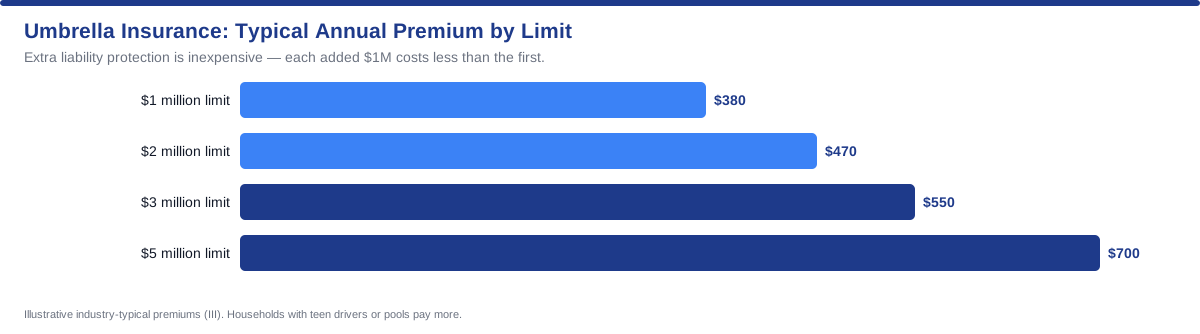
- Base layer size: the first $1M is the most expensive; each subsequent $1M typically adds only $50–$100/year.
- Underlying limits: most insurers require $250k/$500k auto and $300k home liability before they'll issue umbrella, and meeting that keeps your rate lower.
- Risk attachments: teen drivers, multiple vehicles, pools, and certain dog breeds raise the price because they raise the chance of a large claim.
- Prior incidents: a recent at-fault accident or liability claim can add a surcharge or reduce available carriers.
Coverage Gaps Umbrella Fills
- Personal liability overflow: protects against judgments above your home/auto limits.
- Personal injury: covers libel, slander, false arrest, and invasion of privacy — generally excluded from base policies.
- Worldwide coverage: many umbrella forms extend protection even when you're traveling abroad.
- Landlord liability: if you rent out property, umbrella can sit above the landlord policy's liability limit.
Methodology and Assumptions
This tool produces an educational estimate, not a bound quote. Real pricing depends on your carrier, your underlying policy details, your motor vehicle record, and your prior claims. We use representative rate relationships (first $1M ≈ $150–$300/yr; each added $1M ≈ $50–$100/yr) drawn from commonly published ranges; your actual premium will vary. Always confirm with a licensed agent before purchasing.
Reading Your Estimate
The calculator returns a recommended total layer and the incremental cost of $1M and $2M slices. Read the recommendation as a floor anchored to your net worth: if the tool suggests $1M but your assets are $1.5M, the honest answer is "at least $1.5–2M." The risk profile flag tells you whether features like a teen driver or a pool are quietly raising both your need and your price, which is useful when you talk to an agent.
Umbrella vs. Simply Raising Underlying Limits
You can raise your auto or home liability limits, but doing so gets expensive quickly and still caps out far below what an umbrella provides. An umbrella is the efficient way to reach $1M–$5M because the first million of underlying coverage is comparatively cheap and the excess layer on top is cheaper still per dollar of protection. Most carriers require a baseline of $250k/$500k auto and $300k home before they'll issue the umbrella, so meet that first.
Common Mistakes
- Assuming renters don't need it: liability follows the person, not the deed — renters with assets are exposed too.
- Buying only $1M when net worth is higher: a judgment can reach future income, not just current savings.
- Skipping it to save $200/year: the leverage (large protection per dollar) is unmatched by any other policy.
- Forgetting it sits atop all policies: you need the underlying home/auto liability in place first.
When to Buy
Buy as soon as your assets or income make a large judgment worth protecting — commonly once net worth crosses $250k–$500k, or earlier if you have a high-earning household, teenage drivers, or liability-attracting features. Premiums rise with risk profile, so locking in coverage while your record is clean is cheaper than waiting until after an incident.
A Sample Scenario
A couple with $600k in home equity, $200k in investments, and a $150k household income has roughly $950k in attachable net worth plus future earnings. A $1M umbrella at, say, $200–$300/year sits above their $300k home and $500k auto liability, meaning a catastrophic $1.5M judgment would be covered instead of forcing a fire sale of the house and investments. That math is why the calculator's asset-based recommendation points where it does.
☂️ Umbrella Insurance Estimator
Umbrella insurance provides additional liability protection above your auto and homeowners limits. Estimate your needed coverage and cost.
Related Articles
How to Choose an Insurance Company
Compare financial strength and complaints
The Insurance Claims Process
Step-by-step from filing to payout
Read Your Declarations Page
Decode your policy summary
Deductible vs. Premium
The trade-off that sets your cost
Umbrella Insurance FAQ
Umbrella insurance provides excess liability coverage above your auto and homeowners insurance limits. It covers: (1) Bodily injury liability (someone sues you for injury), (2) Property damage liability (you damage someone's property), (3) Landlord liability (if you rent out property), (4) Coverage for incidents not covered by standard policies (libel, slander, false arrest). Most policies offer $1M-5M in coverage.
Financial experts recommend umbrella coverage equal to your total net worth (assets minus debts). If you have $500K in assets, get at least $500K-1M in umbrella coverage. If you have $2M+ in assets, consider $2-5M. Remember: plaintiffs can go after your future income too, not just current assets.
Umbrella insurance is surprisingly affordable. A $1M policy typically costs $150-300 per year if you already carry $250/500K in auto/hone liability. Each additional $1M in coverage adds only $50-100. It's among the best value insurance you can buy. Use our calculator to estimate your cost.
Yes! Even if you don't own a home, you can still be sued for: (1) Causing a car accident with injuries, (2) Your dog biting someone, (3) A guest injuring themselves at your rental. Renters should have umbrella insurance if their net worth exceeds $300K. The cost is the same whether you own or rent.
Yes. Umbrella is anchored to your auto and renters liability, not to homeownership. A renter with a car, a dog, or a savings cushion can still face a large liability judgment, and the premium is the same whether or not you own property. The only requirement is carrying the underlying auto/renters liability limits the insurer specifies.
Personal umbrella often excludes business activity, and renting out a property (especially short-term) can be treated as a business. If you landlord a property or host guests for pay, tell your agent: you may need a landlord liability endorsement or a commercial umbrella rather than the standard personal policy, which could otherwise deny a claim.
Often, yes. A paid liability claim is recorded and can raise the price at renewal, and a severe claim may make some carriers decline to renew. That is precisely why the coverage exists — the premium is the price of transferring a potentially catastrophic loss. Shopping the umbrella with your auto/home insurer as a bundle usually yields the most stable pricing.
Particularly so. Young families often have rising income (future earnings are attachable), cars full of passengers, and a mortgage — a triple of liability exposure. Because the first million is cheap and you're locking in coverage before any incidents appear on your record, starting an umbrella early is usually cheaper than waiting until a claim or a teen driver forces the issue.
Getting the Right Umbrella: 5 Steps
- Tally your net worth. Add up assets minus debts, then add a buffer for future income a court could attach. This number is your coverage floor.
- Check your underlying limits. Confirm auto liability is at least 250/500 and home liability around 300k; most carriers won't issue umbrella without that foundation, and meeting it also lowers the rate.
- Quote your current insurer first. Bundling umbrella with your existing auto/home policy is almost always the cheapest path, then compare one or two standalone carriers.
- Pick the layer deliberately. Choose $1M, $2M, or $5M based on net worth and risk features (teen drivers, pools, rentals) rather than defaulting to the minimum.
- Reassess after life changes. A new home, a paid-off mortgage, a growing business, or a teenage driver all change your exposure — revisit the limit at each renewal.
Umbrella is the rare insurance that is both cheap per dollar of protection and broadly misunderstood; most households that own a home or car and have any meaningful savings benefit from at least a $1M layer.
Key Terms to Know
- Excess liability
- Coverage that pays only after your underlying auto/home limits are exhausted.
- Net worth
- Your assets minus debts; the usual anchor for how much umbrella you need.
- Underlying limits
- The auto and home liability amounts that must be in place before umbrella applies.
- Personal injury (umbrella)
- Libel, slander, false arrest, and similar claims usually excluded from base policies.
- Attachable income
- Future earnings a court can garnish after a judgment — why young earners need protection.
📎 You Might Also Need
Based on your umbrella insurance calculation, you may also want to estimate these costs:
People Also Ask About Umbrella Insurance
Do I need umbrella insurance?
Consider it once your savings, home equity, and future earnings exceed the liability limits on your auto and home policies. A serious lawsuit or major at-fault accident can blow past standard limits quickly, and umbrella coverage is relatively inexpensive per million dollars of protection.
How much umbrella coverage should I have?
A common rule is enough to cover your net worth plus future earning potential—most households start at $1 million and add $1M increments up to $5M or more as assets grow.
Does umbrella insurance cover my rental property?
Personal umbrella policies generally extend to rental properties you own as investments for personal liability, but regular business activity (like short-term rentals) may require a commercial endorsement. Check the specific policy language.
Sources & References
Our umbrella (excess liability) insurance estimates and explanations are built from publicly available regulatory data, industry research, and guidance from the U.S. Department of Housing and Urban Development (HUD) on property and liability exposure. These figures are planning estimates only.
Links are provided for verification only. InsureCostCalc.com is not affiliated with, endorsed by, or sponsored by any government agency or organization listed above. See our full references list.