Home vs. Renters: What This Calculator Estimates
This single tool serves both homeowners and renters. For a homeowner, it estimates the six standard HO-3 coverages — dwelling, other structures, personal property, loss of use, personal liability, and medical payments — anchored to your home's rebuild cost. For a renter, it estimates the four coverages that matter without the dwelling: personal property, loss of use, liability, and medical payments. It also surfaces a flood add-on estimate, since flood is excluded from every standard policy.
How the Estimate Is Built
The calculator combines your rebuild cost (or, for renters, your belongings value) with location-based loss costs, your selected deductible, and liability limit to produce an annual and monthly figure. It also recommends a deductible calibrated to your premium and flags the separate flood-insurance piece so the true cost of protecting your home isn't understated.
The Biggest Cost Drivers
- Rebuild cost, not market value: insurance pays to reconstruct the structure, so land value shouldn't inflate your limit.
- Location risk: wildfire, wind/hail, coastal, and crime exposure push premiums up sharply in high-risk areas.
- Home age and systems: an older roof, knob-and-tube wiring, or outdated plumbing raises rates; updates earn credits.
- Claims history: prior losses follow you via industry claims databases.
- Credit-based insurance score: used in most states and strongly predictive of claims.
- Deductible: a higher deductible lowers the premium but raises your out-of-pocket at claim time.
Why Renters Shouldn't Skip It
Your landlord's policy covers the building, not your laptop, furniture, or liability if a guest is hurt. A renters policy — essentially the contents-and-liability half of a homeowners policy — is among the cheapest insurance you can buy and prevents a single theft or kitchen fire from becoming a major out-of-pocket loss.
Methodology and Assumptions
This is an educational estimate, not a bound quote. Real pricing depends on your carrier, exact construction, endorsements, and discounts. We apply representative rate relationships to your inputs; your actual premium will vary by state and insurer. Confirm with a licensed agent before purchasing, and remember flood coverage must be bought separately.
Reading Your Estimate Correctly
The calculator returns an annual and monthly figure plus a recommended deductible and a separate flood add-on. The dwelling number is built from your rebuild cost, not your purchase price, so a high land value shouldn't inflate it. The liability figure is the backbone of your protection — most households should carry at least $300,000, with an umbrella on top if assets exceed that. The flood add-on is shown separately on purpose: it is never included in a standard policy and must be bought on its own.
Home vs. Renters: Setting the Right Limits
Homeowners should set dwelling coverage to full rebuild cost and contents to 50–70% of that. Renters skip the dwelling entirely and instead size their contents limit to the actual replacement value of belongings — a furnished one-bedroom might need $20k–$40k, a larger home $60k–$100k+. Both groups should carry at least $300k liability and consider an umbrella if net worth is higher.
Common Coverage Mistakes
- Insuring to market value: you pay to rebuild the structure, not the land.
- Assuming flood is included: it never is, in any standard form.
- Skipping the inventory: claims stall without proof of belongings.
- Choosing the cheapest deductible blindly: match it to savings you actually have.
- Letting liability sit at the state minimum: it rarely matches real exposure.
When to Review Your Policy
Review at every renewal and after any major change: a renovation that adds square footage, a paid-off mortgage, a new expensive item (jewelry, art) worth scheduling, or a move to a different risk zone. Rising rebuild costs after regional disasters can leave long-time owners underinsured without realizing it, so periodically bumping Coverage A is prudent.
A Sample Scenario
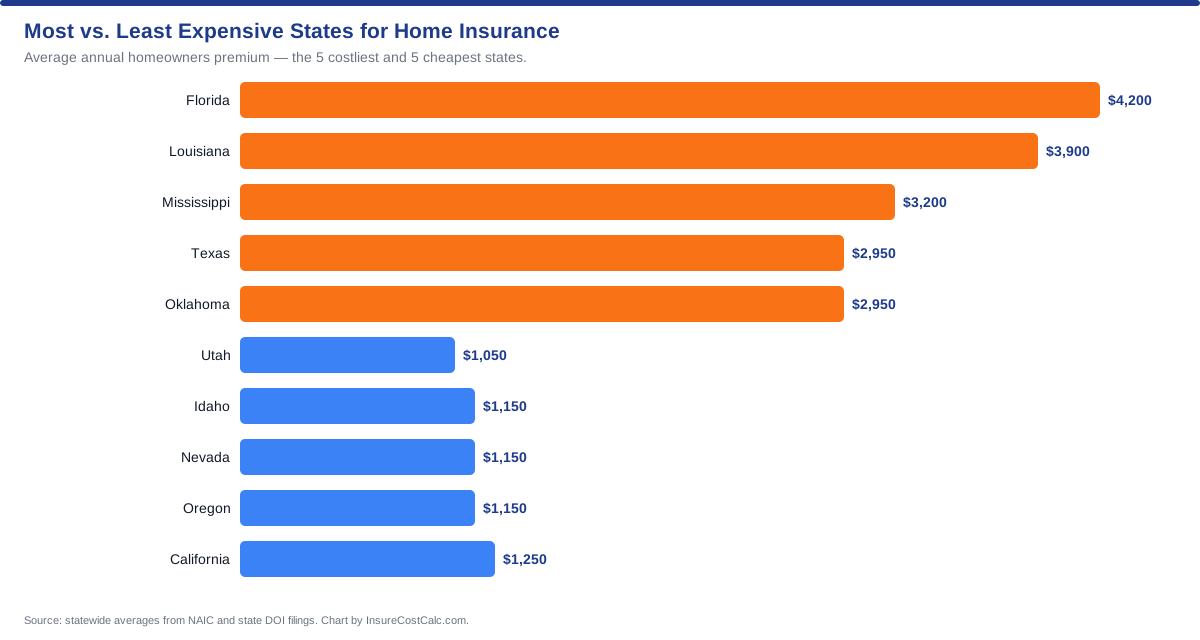
A homeowner with a $400,000 rebuild cost in a moderate-risk inland state might see an estimate around $1,400–$1,900/year with a $1,000 deductible and $300k liability. Move that same home to a coastal wind/hail zone and the premium can climb well past $3,000; add a flood policy and the protection stack grows further. The calculator isolates each piece so you can see which factor is driving the price.
🏠 Home & Renters Insurance Calculator
Get an instant estimate for your home or renters insurance premium based on property details and location.
Related Articles
What Is Homeowners Insurance
Coverage, perils, and policy structure
Renters Insurance Guide
Protect your belongings affordably
Bundle Home & Auto
When combining policies saves or costs
Deductible vs. Premium
The trade-off that sets your cost
Home & Renters Insurance FAQ
Insure to the full rebuild cost of your home, not its market price. A local per-square-foot rebuild estimate or your insurer's replacement-cost calculator is the right input. Under-insuring to save a little on premium is risky if a total loss occurs.
No. Standard policies exclude both. Flood insurance is bought separately through the NFIP or private markets; earthquake coverage is a separate endorsement. If you're in a high-risk zone, budget for these explicitly rather than assuming the base policy has you covered.
Pick the highest deductible you could comfortably pay from savings. Common choices are $500, $1,000, and $2,500; each step up lowers your premium. In catastrophe-prone regions a percentage-based wind/hail deductible may also apply, so read the policy language.
Strongly recommended. A photo or app-based inventory of your belongings dramatically speeds personal-property claim settlements and prevents disputes over what you owned. Store it off-site or in the cloud so it survives a home loss.
A standard homeowners policy gives only very limited coverage for business property and usually none for liability from business activity. If you run a business from home, you generally need a home-business endorsement or a separate business policy — especially if clients visit, you keep inventory, or you have expensive equipment. Don't assume the base policy has you covered.
Standard policies cap high-value items — often $1,500–$2,500 for jewelry and similar limits for art or collectibles. To fully protect valuables, schedule them with a separate endorsement that states each item's agreed value; this also typically removes the deductible for those items and broadens covered causes. Keep appraisals and receipts as proof.
If a tree falls on your house, dwelling coverage generally pays to repair the damage (minus your deductible), and most policies also pay to remove the fallen tree up to a modest limit. If a healthy tree simply falls in your yard without hitting a structure, removal is usually on you. Damage from a tree you neglected (dead, obviously hazardous) may be disputed, so maintain trees near the home.
Getting the Right Policy: 5 Steps
- Set dwelling to rebuild cost. Insure the structure for what it costs to rebuild, not its market price — land value shouldn't inflate the limit.
- Size your contents. Homeowners target 50–70% of dwelling; renters estimate the actual replacement value of belongings, not a guess.
- Carry at least $300k liability. Most households need that floor, with an umbrella on top if net worth is higher or risk features exist.
- Add the right endorsements. Replacement-cost contents, water backup, and scheduled valuables close the most common gaps; flood must be bought separately.
- Re-shop and review annually. Rising rebuild costs and life changes can leave you underinsured; revisit limits and quotes every renewal.
Run the estimate, then use it as the starting point for three quotes — an insurer that prices your rebuilt cost, deductible, and liability differently can swing your premium by hundreds of dollars for the same protection.
Key Takeaways
- Insure to rebuild cost, not market value. The land isn't at risk of burning, so your dwelling limit should reflect construction cost, not your purchase price.
- Flood and earthquake are always excluded. No standard policy covers them; buy separate flood (NFIP or private) and earthquake coverage where the risk exists.
- Renters need protection too. A renters policy covers your belongings and liability for a fraction of a homeowners premium — skipping it leaves a real gap.
- Review annually as costs rise. Rebuild costs climb after disasters and life changes shift your needs, so revisit limits and quotes every renewal rather than auto-renewing blindly.
Editorial note: This page is original educational content written to help you understand home and renters insurance and use our calculator more effectively. It is not insurance advice, and rates vary by carrier, state, and individual risk. Confirm any decision with a licensed agent, and remember that flood and earthquake coverage must be purchased separately from a standard policy.
Key Terms to Know
- Dwelling coverage (A)
- Pays to rebuild the structure; set it to rebuild cost, not market value.
- Replacement cost
- Pays to rebuild at today's prices with no depreciation — the basis you want.
- Actual cash value
- Pays depreciated value; often the default for contents unless you add replacement cost.
- Loss of use (D)
- Covers hotel and meal costs when a covered loss makes your home uninhabitable.
- Scheduled personal property
- An endorsement that fully covers jewelry, art, and valuables above default sub-limits.
📎 You Might Also Need
Based on your calculation, you may also want to estimate these insurance costs:
People Also Ask About Home & Renters Insurance
How much is homeowners insurance per month?
The national average is about $125 per month ($1,500 per year), but it varies widely by state, home value, age, construction, and claim history. Renters insurance is far cheaper—often $15–$30 per month for $30,000 of personal property coverage.
Is renters insurance required by law?
No state law mandates renters insurance, but many landlords require it in the lease because it protects the building and your belongings. Even when optional, it is one of the cheapest ways to cover theft, fire, and liability.
Does homeowners insurance cover water damage?
Sudden and accidental water damage—like a burst pipe—is usually covered. Long-term seepage, sewer backup, and flood are typically excluded or limited; flood needs a separate NFIP or private policy.
Sources & References
Our home and renters insurance estimates and explanations are built from publicly available regulatory data, industry research, and guidance from the U.S. Department of Housing and Urban Development (HUD) on property and renters coverage. These figures are planning estimates only.
Links are provided for verification only. InsureCostCalc.com is not affiliated with, endorsed by, or sponsored by any government agency or organization listed above. See our full references list.