How We Build & Review Our Estimates
InsureCostCalc.com is a free editorial resource, not an insurance seller. Every calculator and guide is built on public data and reviewed by our editorial team against current regulatory filings before it goes live.
We are operated by an independent editorial team focused on insurance literacy. We are not affiliated with any carrier or agency, and our tools are built to educate—not to capture your contact information for sales calls. Every page carries a visible "last updated" date and is re-checked against public regulatory data on a regular schedule.
Transparent Methodology
Our estimates apply industry-standard rating factors—coverage limits, deductibles, location, age, and risk tier—to baseline loss costs published by regulators and rating agencies.
Editorial Review
Each tool and article is reviewed by our editorial team against current state insurance department filings and NAIC guidance before publication and at least once a year thereafter.
Private & Independent
We collect no personal information and sell no leads. Our only revenue is contextual advertising, which never influences our estimates or rankings.
Sources we rely on
Our data and methodology draw on public, authoritative sources, including:
- National Association of Insurance Commissioners (NAIC) — national market data and consumer guides
- Insurance Information Institute (III) — average premium and loss statistics
- State Insurance Departments — approved rate filings and minimum-coverage laws
- FEMA / National Flood Insurance Program (NFIP) — flood zones and pricing
- CMS & Healthcare.gov — ACA premium and subsidy rules
- ISO / Verisk & CFPB — loss costs and consumer-protection guidance
Our reader promise
- No personal data, ever. Our calculators run in your browser and never ask for your name, email, or phone number.
- No sales, no leads. We do not broker insurance or sell your details to agents. We are an educational publisher, not a quote marketplace.
- Honest about limits. We label every figure as an estimate and point you to a licensed agent for a bindable quote.
Meet the team & read our editorial standards →
Estimates are educational and not a substitute for a quote from a licensed agent. Rates change frequently; we refresh our baselines as new public data is released. Last methodology review: July 2026.
5 Insurance Cost Myths, Debunked
Misconceptions about what drives your premium can lead to over-insuring (wasted money) or under-insuring (real risk). Each is a pattern we see repeatedly in reader questions and in the way quotes are presented. Clearing them up is the fastest way to avoid paying too much—or too little—for the protection you actually need. Here are five common ones our calculators help you see through.
Myth 1 — "A red car costs more to insure."
Vehicle color has zero effect on auto premiums. Insurers price on the car's make, model, engine size, safety and theft records, repair costs, your driving history, and where you live—not the paint. A red and a beige version of the same car cost the same to insure.
Myth 2 — "Renters don't need insurance."
A landlord's policy covers the building, not your belongings or liability. A fire, theft, or guest injury can cost thousands out of pocket. Renters insurance typically runs $12–$20 a month and is one of the cheapest ways to protect your stuff and your liability.
Myth 3 — "Flood is covered by my homeowners policy."
Standard home and renters policies explicitly exclude flood. Coverage must be bought separately through the NFIP or a private flood insurer. If you're in or near a FEMA flood zone, your lender likely requires it—and even "low-risk" areas file a large share of flood claims.
Myth 4 — "Life insurance is only for the elderly or the wealthy."
Term life is inexpensive when you're young and healthy—often under $30/month for substantial coverage. Locking in a rate early protects your family during the years your income matters most, and the premium never rises during the level term.
Myth 5 — "The minimum coverage my state requires is enough."
State minimums keep you legal but often leave you badly exposed after a serious accident. If damages exceed your limits, your savings and assets can be pursued. Most experts recommend liability limits of at least 100/300 and an umbrella policy once your assets grow.
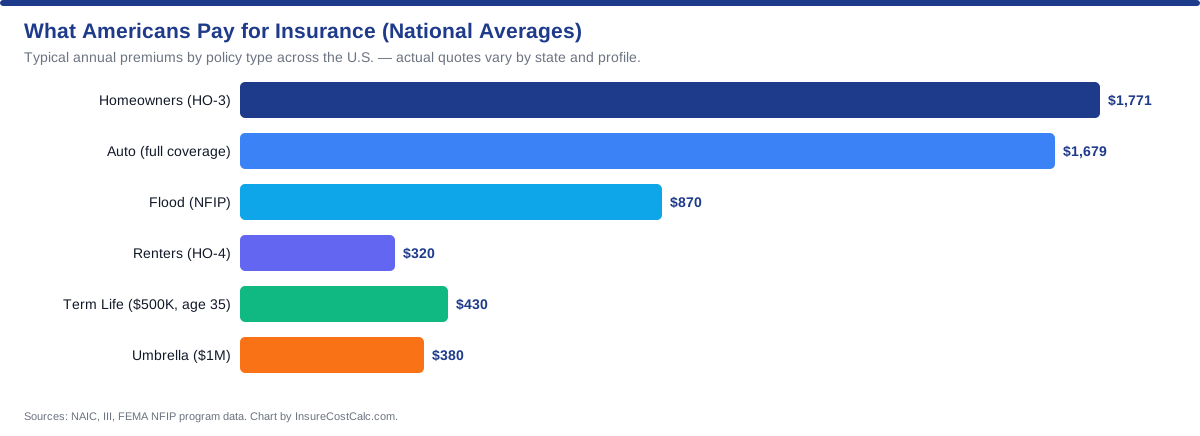
What Actually Drives Your Insurance Cost
Every calculator on this site weighs the factors insurers actually use. The biggest levers differ by product:
- Home & renters: location and catastrophe risk, dwelling or personal-property value, coverage limits, deductible, home age and construction, claims history, and credit-based insurance score (in most states).
- Auto: driving record, age and experience, vehicle make and model, annual mileage, garaging location, coverage limits, and credit-based insurance score (banned only in CA, MA, and MI for auto).
- Life: age, health and tobacco use, coverage amount, term length, and policy type—younger, healthier applicants pay far less.
- Health (ACA): household income (which drives subsidies), age, ZIP code, tobacco use, and the metal tier (Bronze–Platinum) you choose.
- Flood: FEMA flood zone, building elevation relative to the Base Flood Elevation, structure type, and coverage amount.
- Umbrella: the liability limits on your underlying home and auto policies, your risk profile, and the total assets you need to protect.
Because each carrier weights these factors differently, treat the output as a planning estimate—then confirm it with a formal quote from a licensed agent.
How to Use Our Calculators in 3 Steps
Pick your product
Choose the calculator that matches the coverage you're shopping for—home, auto, life, health, flood, or umbrella.
Enter your profile
Adjust the sliders and fields—deductible, limits, ZIP, age, coverage. No sign-up, no personal details required.
Review & act
Read the breakdown, compare scenarios, then take the estimate to a licensed agent for a bindable quote.
Insurance types at a glance
| Type | Protects | Typical cost driver |
|---|---|---|
| Home | Dwelling & belongings | Location risk, rebuild cost |
| Auto | Vehicle & liability | Driving record, age |
| Life | Family income | Age, health, term |
| Health | Medical bills | Income, age, tier |
| Flood | Water damage | FEMA zone, elevation |
| Umbrella | Excess liability | Assets, underlying limits |
Before You Buy: A 5-Point Insurance Checklist
Use our calculators to work through these five steps before you sign a policy. They help you avoid the two most expensive mistakes—over-paying and being under-insured.
- Know your replacement cost, not your market value. For home insurance, cover what it would cost to rebuild—land value isn't insured.
- Match liability to your assets. If your savings exceed your auto or home liability limits, add an umbrella policy rather than hoping nothing happens.
- Raise deductibles you can afford. A higher deductible reliably lowers your premium; just keep enough cash reserved to cover it.
- Compare apples to apples. Get quotes at the same limits and deductibles, then judge price—never compare bare-minimum against full-coverage numbers.
- Ask about every discount. Bundling, safe-driving, home-security, and paperless discounts add up; carriers won't always list them unprompted.
All Insurance Calculators
Pick a calculator to estimate your monthly premium. Each tool is free, private, and takes less than a minute.
Home & Renters
Estimate home or renters insurance cost from property value, location, and risk factors.
Auto Insurance
Estimate car insurance premiums based on vehicle, driver age, and coverage level.
Life Insurance
Calculate term & whole life insurance costs based on age, coverage amount, and health status.
Health Insurance
Estimate your ACA marketplace premium and subsidy based on income and household size.
Flood Insurance
Calculate NFIP and private flood insurance rates based on FEMA flood zone.
Umbrella Insurance
Find out how much umbrella (excess liability) insurance you need and its cost.
📎 You Might Also Need
Based on your calculations, you may also want to estimate these insurance costs:
Frequently Asked Questions
Our estimates are based on industry data from NICB, NAIC, and publicly available rate filings from major insurers like State Farm, Geico, and Progressive. While actual quotes may vary based on your specific circumstances, our estimates provide a reliable baseline for budgeting purposes. Always get formal quotes from licensed agents for exact premium amounts.
No. All calculators on InsureCostCalc.com are completely free and do not require any personal information, registration, or contact details. We do not sell or share any data because we don't collect any.
Insurance rates vary by state due to several factors: (1) State insurance regulations and minimum coverage requirements, (2) Local weather risks (hurricanes, hail, wildfires), (3) Traffic density and accident statistics, (4) Cost of living and medical expenses, (5) Crime rates, and (6) State-specific legal environments. Use our State Guides to see average rates in your state.
Top ways to lower insurance costs: (1) Bundle multiple policies with one insurer, (2) Increase your deductible, (3) Maintain a good credit score, (4) Ask about discounts (safe driver, good student, military, senior), (5) Shop around annually, (6) Reduce coverage on older vehicles, (7) Install security and safety devices, (8) Take a defensive driving course.
Term life insurance provides coverage for a specific period (10, 20, 30 years) and pays a death benefit only if you die during the term. It's much cheaper but has no cash value. Whole life insurance provides lifelong coverage with a cash value component that grows over time. It's more expensive but builds equity. Use our Life Insurance Calculator to compare costs.
No. Standard homeowners and renters insurance policies do NOT cover flood damage. Flood insurance must be purchased separately through the NFIP (National Flood Insurance Program) or private insurers. If you live in a FEMA-designated flood zone, your mortgage lender may require it. Use our Flood Insurance Calculator to estimate your cost.
Financial experts recommend: (1) Bodily Injury: at least $100,000 per person / $300,000 per accident, (2) Property Damage: at least $50,000, (3) Uninsured Motorist: match your bodily injury limits, (4) Comprehensive & Collision: if your car is worth more than $3,000. If you have significant assets, consider an umbrella policy for extra protection.
In most states, yes. Insurance companies use credit-based insurance scores because data shows a correlation between credit history and insurance claims. Poor credit can increase premiums by 50-100%. Only California, Massachusetts, and Michigan prohibit or restrict the use of credit scores for auto insurance pricing. Improving your credit score is one of the most effective ways to lower insurance costs.