What Auto Insurance Actually Covers
A full auto policy bundles several protections, and understanding them helps you choose limits instead of blindly accepting the cheapest quote:
- Bodily injury liability — pays for the other party's medical bills and your legal defense if you cause an injury crash (the two numbers, e.g. 100/300, are per-person / per-accident limits in thousands).
- Property damage liability — pays to repair the other party's vehicle or property you damage.
- Collision — pays to repair your own car after a crash, regardless of fault.
- Comprehensive — pays for non-collision events: theft, fire, hail, falling objects, animal strikes.
- Medical payments / PIP — covers your passengers' and your own medical costs.
- Uninsured/underinsured motorist — protects you when the at-fault driver has too little or no coverage.
How This Calculator Works
Our estimator takes the inputs insurers weigh most: vehicle year and type, driver age, garaging state, credit-based insurance score tier, recent moving violations (including DUI), and your chosen coverage level (state minimum, basic 50/100/50, or full 100/300/100). It outputs a monthly estimate plus side-by-side basic vs. full comparisons and a "local lowest rate" benchmark so you can see the spread between carriers.
The Factors That Move Your Rate Most
- Driver age: teenagers and drivers under 25 pay the most; rates generally fall through the 30s–50s, then rise modestly after ~70.
- Driving record: a single ticket can add 20–30%; an at-fault accident 40–50%; a DUI often doubles or triples the base for years.
- Vehicle type: sports, luxury, and electric vehicles cost more to repair and insure; sedans and safe family SUVs tend to be cheaper.
- Credit tier: used in most states, a poor score can raise premiums 30–50%+ versus excellent.
- Coverage level: minimum liability is cheapest but leaves you exposed; full coverage costs more but protects your own car.
Why Rates Vary So Much by State
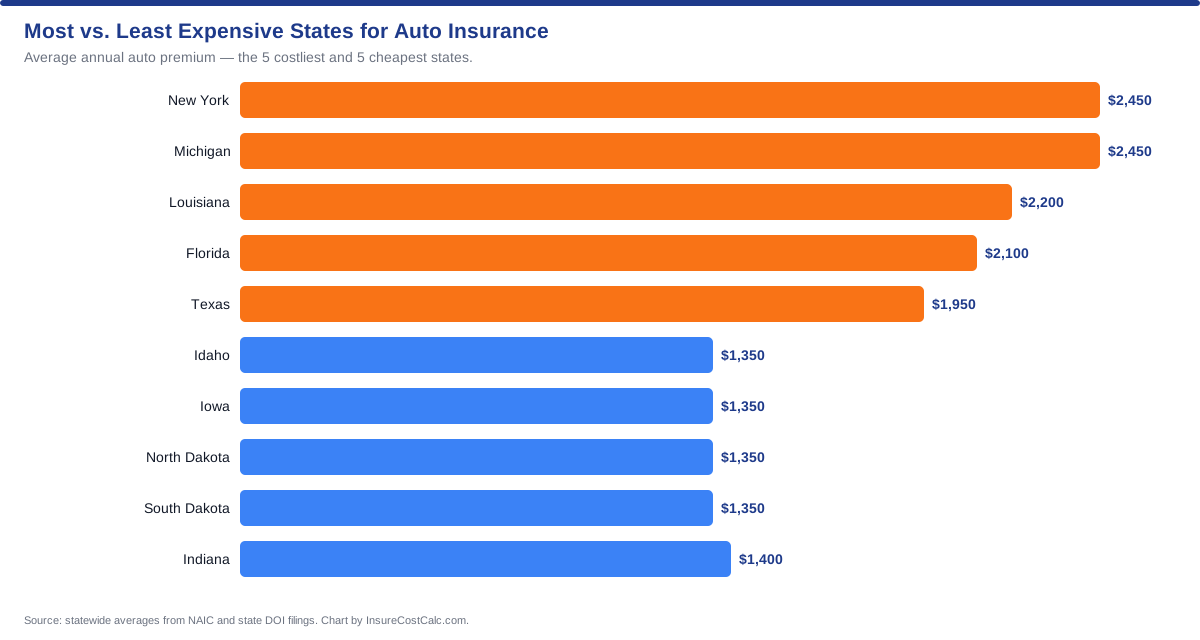
Each state sets its own rules on allowable rating factors, required minimums, and litigation environment. States with heavy litigation, dense urban traffic, or severe weather (hurricanes, hail) run higher average premiums; rural, low-litigation states run lower. Our state insurance guides break down the dominant cost drivers for each state.
Methodology and Assumptions
This tool returns an educational estimate, not a bound quote. Actual premiums depend on your exact carrier, vehicle trim, annual mileage, prior claims, and discounts. We apply representative rate relationships to your inputs; your real price will differ. Confirm any number with a licensed agent or direct quote before you buy.
Reading Your Estimate Correctly
The calculator returns a monthly figure, but that number only means something once you know what sits inside it. The "basic" column reflects 50/100/50 limits with no physical-damage coverage on your own car; the "full" column adds collision and comprehensive at 100/300/100. The gap between them is the price of protecting your own vehicle, and whether it's worth it depends on your car's value (see the drop-collision logic above). The "local lowest rate" benchmark shows the spread between carriers for identical coverage — that spread is your shopping opportunity.
Full Coverage vs. Liability-Only: Which to Choose
If you have a loan or lease, your lender requires comprehensive and collision — there's no choice. If you own the car outright, the decision is financial: keep full coverage while the car is worth enough that a total loss would hurt, and drop the physical-damage portion once the premium approaches the car's depreciated value. Never drop liability, which is what protects you from lawsuits after an at-fault crash.
Common Quoting Mistakes
- Comparing unequal limits: a cheap quote that quietly lowered your bodily-injury limit isn't a saving, it's a downgrade.
- Ignoring the deductible: a low deductible feels safe but raises the premium; match it to your emergency fund.
- Forgetting discounts: telematics, good-student, multi-car, and paid-in-full are often left on the table.
- Only quoting one carrier: you have no benchmark and likely overpay.
- Letting it auto-renew: loyalty rarely pays in auto insurance; re-shop every renewal.
When to Re-Shop Your Policy
Re-shop when a life change alters your risk profile: a move, a paid-off loan, a teen added or removed, marriage, or a cleaner record after a violation ages off. Even without a trigger, getting three fresh quotes annually is the single highest-confidence way to keep your rate honest, because the "loyalty tax" compounds silently year over year.
A Sample Scenario
Consider a 35-year-old in California driving a 2018 sedan with good credit and a clean record, carrying full 100/300/100 coverage. The estimator might return roughly $150–$190/month depending on ZIP code. Raise the deductible from $500 to $1,000 and the same driver could see $130–$165/month. Add a teen driver and the figure can roughly double — which is exactly why the calculator's inputs matter and why shopping becomes essential the moment your household changes.
🚗 Auto Insurance Cost Estimator
Estimate your monthly car insurance premium based on vehicle, driving history, and location.
Related Articles
How to Lower Car Insurance
Proven ways to cut your auto premium
The Insurance Claims Process
Step-by-step from filing to payout
How to Choose an Insurance Company
Compare financial strength and complaints
Read Your Declarations Page
Decode your policy summary
Auto Insurance FAQ
Only if you have very little to lose. Minimum limits satisfy the law but often fall far short of a real injury claim, leaving your savings and assets exposed. For most drivers with any meaningful net worth, basic or full coverage is the safer value.
Often yes, once the car's market value is low (a common threshold is under $3,000–$4,000). Run the math: if the annual physical-damage premium approaches what a claim would pay after the deductible, the coverage isn't earning its keep. Keep liability regardless.
Industry-wide repair, parts, medical, and litigation costs rise most years, and insurers file rate increases accordingly. Your individual price also drifts with credit changes, added drivers, a relocated garaging address, or the loss of a prior discount. Re-shopping at renewal is the most reliable counter.
In most states a credit-based insurance score is a legal and common rating factor. California, Massachusetts, Michigan, and Hawaii restrict or prohibit its use to varying degrees, so the impact depends on where you live.
An SR-22 is not insurance but a state filing your insurer submits proving you carry the required liability limits — typically after a DUI, a serious violation, or driving without insurance. It usually must be maintained for about three years, and carriers that file it often charge a surcharge on top of already-elevated rates. Not every insurer offers SR-22 filings, so shopping matters even more in this situation.
Auto policies primarily follow the vehicle, so if you lend your car, your insurance generally responds first. But drivers listed on your policy are covered in any covered vehicle, and permissive users may be covered too, subject to exclusions. If someone regularly drives your car, list them on the policy — failing to do so can lead to a denied claim.
Ideally not at all, since you weren't responsible. In practice some states and insurers still factor in any accident on your record, and repairs paid by the other driver's liability shouldn't hit your own claims history. If your rate rises after a clearly not-at-fault crash, ask the insurer to reclassify it and compare quotes — the difference between carriers can be significant.
Getting the Right Auto Policy: 5 Steps
- Decide your coverage tier. Minimum liability is cheapest but risks your assets; basic or full is safer. Keep full coverage on any car you couldn't easily replace.
- Match the deductible to savings. A higher deductible lowers the premium; set it to an amount you could actually pay after a claim without strain.
- Capture every discount. Telematics, good-student, multi-car, paid-in-full, and defensive-course credits are often left on the table — ask the agent to run the full list.
- Get three quotes. Rates for identical coverage vary widely, so benchmark at least three carriers and re-shop at every renewal.
- Watch your record and credit. Clean driving and a strong insurance score are the levers you control; a single violation or weak score can add hundreds per year.
Use the calculator to see how each input — age, vehicle, state, credit, violations, coverage level — shifts your monthly number, then take the three quotes into that conversation so you're comparing real prices, not guesses.
Key Takeaways
- Shop at least three carriers. Loyalty rarely pays in auto insurance, and the spread between quotes for identical coverage is your clearest savings lever.
- Match coverage to the car's value. Keep full coverage while the vehicle is worth protecting, then drop collision and comprehensive on an older car you could replace out of pocket.
- Use deductibles and discounts together. A higher deductible plus every available discount (telematics, multi-car, paid-in-full) compounds into meaningful savings.
- Protect your assets with liability. Minimum limits are cheapest but leave savings exposed; carry limits that match your financial profile, not just the legal floor.
Key Terms to Know
- Bodily injury liability
- Pays the other party's medical bills and your legal defense after an at-fault injury crash.
- Property damage liability
- Pays to repair the other driver's vehicle or property you damage.
- Collision
- Covers repairs to your own car after a crash, regardless of fault.
- Comprehensive
- Covers theft, fire, hail, and animal strikes — non-collision events.
- Full coverage
- Liability plus collision and comprehensive; required by most lenders on a financed car.
📎 You Might Also Need
Based on your calculation, you may also want to estimate these insurance costs:
People Also Ask About Auto Insurance
How much is car insurance per month in the U.S.?
The national average for full coverage is roughly $150–$220 per month (about $1,800–$2,600 per year). Your rate depends on age, driving record, vehicle, ZIP code, credit-based score where allowed, and coverage limits. Enter your details in the calculator above for a personalized estimate.
Is auto insurance required by law?
Almost every state requires liability coverage (or proof of financial responsibility) to drive legally. New Hampshire and Virginia are the main exceptions, though both still expect you to pay for at-fault damages. Driving uninsured can mean fines, license suspension, and impoundment.
Why did my car insurance rate go up?
Common triggers include an at-fault accident or moving violation, a lapse in coverage, relocating to a higher-risk ZIP code, and broader inflation in repair and medical costs. Shopping around at renewal and raising your deductible can soften the increase.
Sources & References
Our auto insurance estimates and explanations are built from publicly available regulatory data, industry research, and reporting from Experian on how credit-based insurance scores affect auto rates. These figures are planning estimates only.
Links are provided for verification only. InsureCostCalc.com is not affiliated with, endorsed by, or sponsored by any government agency or organization listed above. See our full references list.