Car insurance is one of the few bills you can often reduce by 20% or more without sacrificing real protection — but only if you know which levers actually move the price. This guide walks through 15 strategies that work in 2026, how to apply them in the right order, and the common traps that keep premiums high.
Estimate Your Car Insurance Cost First
Before negotiating, know your baseline. Our free calculator gives a personalized estimate in seconds.
Open the Auto Insurance Calculator →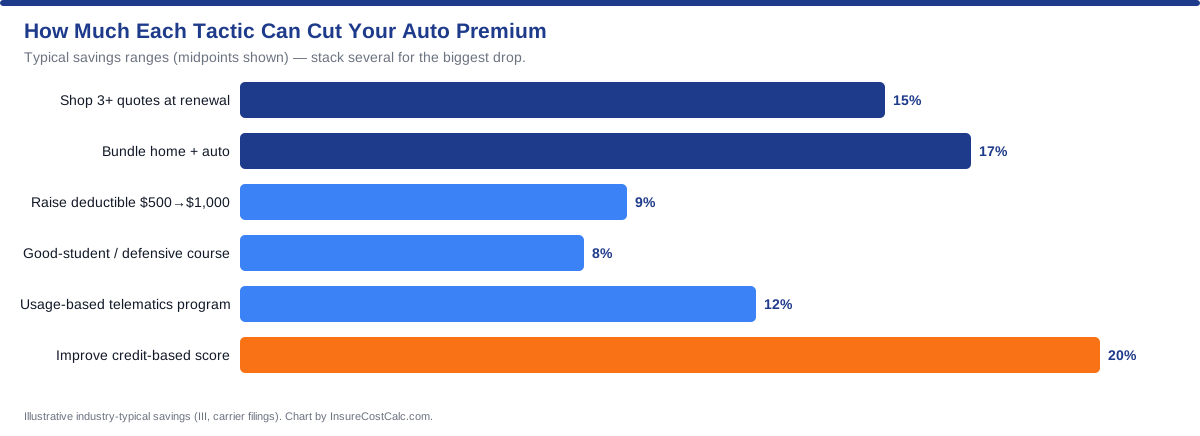
Why Your Premium Moved (and Why It's Controllable)
Auto premiums are built from a base rate multiplied by dozens of rating factors. Insurers file these rates with state regulators, and the factors they may use vary by state. The key insight: roughly half of what you pay is driven by your choices — vehicle, deductible, mileage, discounts, and which company you pick. The other half is largely fixed (your state's loss costs, inflation in repair and medical bills). That "your half" is exactly where the savings live.
Think of lowering your premium as a sequence, not a single switch: first stop overpaying for coverage you don't need, then capture every discount you already qualify for, then re-shop the whole policy. Doing them out of order leaves money on the table.
1. Shop Around and Compare Quotes (the Biggest Lever)
Rates for identical coverage can differ by 50% or more between insurers because each company weighs risk differently and chases different customer profiles. The single most reliable way to save is to get quotes from at least three carriers every renewal. Independent agents and comparison sites help, but also quote a direct writer and a regional mutual — they don't always show up in the same places.
How to compare fairly: match the liability limits, deductible, and coverage types exactly across all three quotes. A "cheaper" quote that quietly dropped your bodily-injury limit from $100k/$300k to $25k/$50k isn't a saving — it's a downgrade. Potential savings: $300–$800/year.
2. Raise Your Deductible
Your deductible is what you pay before insurance kicks in. Moving from $500 to $1,000 commonly cuts the collision and comprehensive portion of your premium by 15–30%. Before doing this, keep the extra $500 in a savings account so a claim doesn't become a cash-flow crisis. Potential savings: $200–$500/year.
3. Bundle Home (or Renters) and Auto
Most major insurers offer a multi-policy discount of 10–25% when you hold your auto and home/renters policies together. The discount is real, but still re-shop both lines periodically — a bundle can hide an overpriced home policy. Potential savings: $300–$700/year.
4. Keep a Clean Driving Record
Surcharges for violations are among the most expensive rating factors. A single speeding ticket often adds 20–30%; an at-fault accident can add 40–50% and linger for three to five years. Defensive, attentive driving is unpaid but high-yield. Potential savings: $400–$1,000/year versus a driver with recent incidents.
5. Improve Your Credit-Based Insurance Score
In most states, insurers use a credit-based insurance score because it is statistically predictive of claims. Moving from a poor to a good score can cut premiums substantially — often 30–50% or more. Not allowed: California, Massachusetts, Michigan, and Hawaii restrict or prohibit the practice to varying degrees. Paying bills on time, lowering credit utilization, and correcting report errors are the levers here. Potential savings: $300–$800/year.
6. Ask for Every Discount You Qualify For
Carriers rarely volunteer every discount. Ask the agent to run the full list. Common ones include:
- Good driver: 10–30% for a clean record
- Good student: 10–25% for a GPA around 3.0 or higher
- Low mileage: 5–15% if you drive under roughly 10,000 miles/year
- Multi-car: 10–25% for insuring multiple vehicles
- Defensive driving course: 5–10% in many states
- Paperless / autopay: 2–5% combined
- Telematics enrollment: an upfront discount just for signing up
7. Drive a Car With Safety and Anti-Theft Features
Vehicles equipped with automatic emergency braking, anti-lock brakes, airbags, and passive anti-theft systems often qualify for discounts. When car shopping, check the insurance group rating — two similar-priced cars can carry very different premiums because of repair costs and theft rates. Potential savings: $50–$200/year.
8. Drop Comprehensive and Collision on Older Cars
If your car's market value is low (a common rule of thumb is under $3,000–$4,000), the annual cost of full coverage can approach or exceed what a claim would pay after the deductible. Run the math: if comprehensive + collision costs $400/year and your car is worth $3,000 with a $500 deductible, your max payout is $2,500 — and you'd pay $1,200 over three years just for the chance. Potential savings: $200–$400/year.
9. Pay Annually or Switch to EFT
Monthly installment plans frequently add 3–10% in fees. Paying the full term upfront, or at least moving to automatic bank withdrawals, removes most of that surcharge. Potential savings: $30–$100/year.
10. Relocate (or Just Re-Rate) Your Garaging Address
Where the car is "garaged" overnight drives a large share of the price through theft, vandalism, and accident frequency in that ZIP code. If you've moved, even within the same city, tell your insurer — rates can drop. Choosing a home in a lower-risk area when relocating can quietly save $100–$500/year. Potential savings: $100–$500/year.
11. Review Coverage After Major Life Changes
Marriage, a new commute, retirement, a teen driver leaving the household, or paying off a loan all change your risk profile and your required coverages. Review at every renewal; many drivers simply let the policy auto-renew for years and miss new eligibility. Potential savings: varies, often $100–$400/year.
12. Try Usage-Based / Telematics Insurance
Programs like Progressive Snapshot, State Farm Drive Safe & Save, and similar track actual driving (miles, braking, time of day) and reward safe habits. Low-mileage or cautious drivers often save 10–30%; risky drivers can pay more, so read the terms. Potential savings: $50–$500/year.
13. Drop Unnecessary Add-Ons
Rental reimbursement, roadside assistance, and gap insurance are useful but sometimes redundant — roadside may already come with your credit card or automaker plan, and gap is only needed while you're upside-down on a loan. Audit each line item. Potential savings: $20–$150/year.
14. Choose Liability Limits Deliberately
State minimums are often far too low to protect your assets in a serious injury claim. Rather than the cheapest legal minimum, set limits that match your financial exposure (many advisors suggest $100k/$300k or higher) — then save on the factors above instead of starving liability. This is about protecting net worth, not just the monthly bill.
15. Time Your Switch Correctly
You can usually switch at any time and get a pro-rated refund from your old insurer; you don't have to wait for renewal. Just avoid a coverage lapse — even a few days without insurance can trigger a "gap in coverage" surcharge at the new company that erases your savings. Line up the start date of the new policy to overlap the old one by a day.
A Simple Savings Worksheet
Use this table to estimate your annual opportunity. Fill in your best guess per line:
| Lever | Low | High |
|---|---|---|
| Re-shop 3 carriers | $300 | $800 |
| Raise deductible | $200 | $500 |
| Bundle home/auto | $300 | $700 |
| Credit score improvement | $300 | $800 |
| Discounts + telematics | $150 | $600 |
| Combined potential | $1,250 | $3,400 |
Most drivers won't capture every line, but $500–$1,200/year in achievable savings is realistic for someone who hasn't shopped in a few years.
Mistakes That Quietly Cost You
- Letting the policy auto-renew blindly — loyalty rarely pays in auto insurance.
- Only getting one quote — you have no benchmark.
- Carrying collision on a clunker — paying more than it's worth.
- A coverage lapse — the "gap" surcharge outlasts the savings.
- Not updating life changes — a moved garage or paid-off loan changes rates.
Your State Changes the Math
Allowed rating factors, required minimums, and even whether credit can be used differ by state. Our state insurance guides break down the rules and typical cost drivers for each state, which helps you target the levers that matter where you live.
Related Articles
The Insurance Claims Process
Step-by-step from filing to payout
How to Choose an Insurance Company
Compare financial strength and complaints
Read Your Declarations Page
Decode your policy summary
Switch Insurance Companies
Move coverage without a lapse
Explore State Guides
California Insurance
Local rates & requirements
Florida Insurance
Local rates & requirements
New York Insurance
Local rates & requirements
Frequently Asked Questions
Studies of quote comparison consistently show meaningful gaps between carriers for the same driver. Many drivers who hadn't re-shopped in several years find $500–$1,200/year in savings. The exact number depends on your record, vehicle, and state, but getting at least three quotes is the highest-confidence step you can take.
In most states, yes — a credit-based insurance score is a common and legal rating factor. Poor credit can raise premiums substantially. California, Massachusetts, Michigan, and Hawaii restrict or prohibit the use of credit for auto insurance to varying degrees, so the impact depends on where you live.
Yes, as long as you can comfortably cover the higher deductible out of savings. Raising it from $500 to $1,000 typically cuts the collision/comprehensive portion by 15–30%. The trade-off is a larger bill if you file a claim, so only do this if the deductible increase sits within your emergency fund.
Generally yes. Your old insurer refunds any unearned premium on a pro-rated basis, and your new policy can start the same day. The critical rule is to avoid any gap in coverage — overlap the policies by a day so there's never a moment you're uninsured.
"Minimum" (liability-only) satisfies your state's legal floor and is cheapest, but pays nothing for your own car after a collision or theft. "Full coverage" adds collision and comprehensive for your vehicle. If your car has any meaningful value or a loan, full coverage is usually worth it; on an older paid-off car, dropping the physical-damage portion is often the smarter saving.
They can. Telematics rewards safe, low-mileage driving, but if the data shows hard braking, late-night driving, or high mileage, your renewal price may rise. Read whether the program is "save only" (discounts never reversed) or "could increase" before enrolling.
Related Tools
Car Insurance Calculator
Estimate your monthly premium
Home & Renters Calculator
Estimate home insurance cost
Life Insurance Calculator
Estimate your life insurance cost
Data sources: NAIC, Insurance Information Institute (III). Last updated: June 2026. This article is original editorial content for educational purposes and does not constitute insurance advice; consult a licensed agent for decisions specific to your situation.