Most shoppers pick an insurer the way they pick a carton of milk — grab the cheapest one on the shelf and move on. Insurance is nothing like milk. The company you choose decides whether a $40,000 claim gets paid in two weeks or turns into a six-month fight, and whether your rate climbs 40% at renewal for reasons you can't see. This guide gives you a repeatable way to choose an insurer on evidence, not on a catchy commercial.
Start With Your Baseline Cost
Before you compare companies, know what you should be paying. Our free calculators give a personalized estimate in seconds.
Open the Home & Renters Calculator →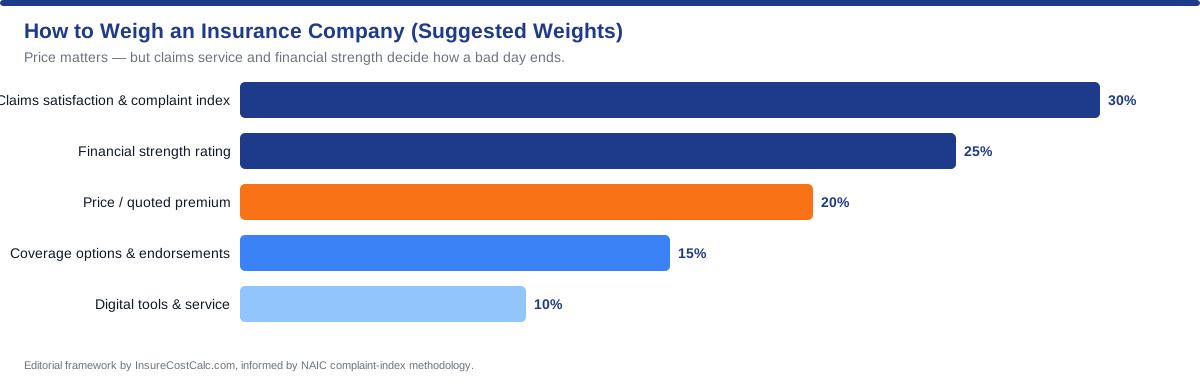
Why the Company Matters as Much as the Price
A premium is the price of a promise. Two companies can quote you the same $1,400, but one pays 98% of claims without a dispute and the other delays, underpays, or denies at twice the industry rate. The difference shows up exactly when you are most vulnerable — after a loss. So the right question is not "who is cheapest?" but "who is cheapest among companies I would trust to pay a claim I can't afford to lose?"
The framework below ranks insurers on six objective signals. None require insider knowledge; all are checkable in under 30 minutes using free public databases.
1. Check Financial Strength Ratings
An insurer must still exist and stay solvent when a hurricane hits and 50,000 claims land at once. Independent rating agencies measure that ability: AM Best is the insurance specialist (look for "A-" or better for stable), while S&P, Moody's, and Fitch also rate the largest carriers. A rating of "A" (Excellent) or above means the company has a very strong capacity to meet commitments. Anything below "B++" deserves a hard second look.
Ratings are not permanent — they get downgraded when a company's reserves weaken. If you have held a policy for years, re-check the rating every couple of years, especially after a major storm season in your region.
2. Read the Complaint Record
The single most underused tool in insurance shopping is the NAIC Complaint Index. Every U.S. state feeds complaint data to the National Association of Insurance Commissioners, which publishes an index where 1.00 is the average complaint level for a given line of business. A company at 2.50 receives complaints at two and a half times the expected rate; a company at 0.40 receives far fewer than expected. This is raw, regulator-sourced signal about how a company treats customers when things go wrong.
Look at the complaint index for your specific product (auto vs. home vs. life are separate). A low price from a carrier with a 3.0 complaint index is often the most expensive policy you can buy, because the "savings" evaporate in a denied claim.
3. Compare Coverage and Policy Wording, Not Just Price
A quote that looks 20% cheaper is sometimes 20% cheaper because it quietly removed something you needed. Two "full coverage" auto quotes can differ on whether they include original manufacturer parts, accident forgiveness, or rideshare coverage. Two "homeowners" quotes can differ on whether water backup, ordinance or law, and extended replacement cost are included. Read the "coverages" page of each quote side by side. The right comparison is identical coverage at the lowest price — never the lowest price alone.
4. Price the Total Cost of Ownership
The premium is only part of what you pay. Add the deductible (what you fork over before a claim pays), the non-covered gaps (flood is excluded from standard home policies, for example), and the realistic chance of a rate increase at renewal. A company with a slightly higher premium but a stable renewal history and a lower deductible that fits your cash flow can be cheaper over three years than a rock-bottom introductory rate that jumps 35% at renewal.
5. Evaluate Claims Service and Reputation
When you file a claim, you are dealing with the insurer's claims operation, not its marketing team. Third-party studies such as J.D. Power's U.S. Auto/Property Claims Satisfaction surveys measure how smoothly claims are handled. App-store ratings of the insurer's mobile app reveal whether you can snap photos and track a claim at 9 p.m. or whether you'll wait on hold. A fast, fair claims process is worth more than a marginally lower premium.
6. Confirm Licensing in Your State
Only licensed insurers are backed by your state's guaranty fund — the safety net that pays claims if a carrier becomes insolvent. Verify a company is licensed in your state through your state insurance department. Unlicensed or "surplus lines" carriers may be legitimate for unusual risks, but they sit outside the guaranty system, so they deserve extra scrutiny and are not where a first-time shopper should land.
7. Weigh Discounts and Bundling
Multi-policy, safe-driver, paperless, and home-security discounts vary widely by company. A carrier that offers a 20% bundle discount plus a telematics program may beat a cheaper base rate elsewhere once savings stack. But never let a discount justify staying with a company that fails steps 1 through 6 — discounts are the last 5% of the decision, not the first.
A Side-by-Side Comparison Worksheet
Use this table to force an apples-to-apples comparison. Score each company before you see the final price.
| Signal | Company A | Company B | Company C |
|---|---|---|---|
| AM Best rating (A- or better?) | |||
| NAIC complaint index (<1.0 ideal) | |||
| Identical coverage match? | |||
| 3-yr renewal stability | |||
| Claims satisfaction score | |||
| Total discounts captured | |||
| Adjusted annual cost |
Red Flags to Avoid
- Pressure to decide "today" — legitimate insurers don't use timeshare-style urgency.
- No verifiable license in your state — check the DOI database first.
- A complaint index far above 1.0 for the product you're buying.
- Vague answers about what's excluded — if they can't name the exclusions, assume the worst.
- A price dramatically below every competitor — cheap for a reason you'll discover after a loss.
8. Read the Fine Print: Endorsements and Exclusions
Two policies with identical limits can still pay wildly different claims based on the policy form underneath. Most large carriers use standardized ISO forms; some use proprietary forms that quietly narrow coverage. The place this shows up is the exclusions and endorsements pages. Look for whether the policy pays replacement cost or actual cash value on your dwelling and belongings - replacement cost is dramatically better after a loss. Check whether "water backup," "ordinance or law" (the cost of bringing an old home up to current code), and "extended replacement cost" (pays 20 to 50% above your limit) are included. A cheaper quote that drops extended replacement cost from 150% to 100% can leave you tens of thousands short after a total loss.
If you have a specialty - a home business, a finished basement, valuable jewelry, a coastal address - ask specifically which endorsements apply. The agent's verbal "you're covered" means nothing until it appears on the dec page and in the form. This single review step catches more bad policies than any rating agency report.
A 15-Minute Pre-Purchase Checklist
Before you bind, run down this list and keep notes:
- AM Best rating "A-" or better confirmed for the exact company name on the quote.
- NAIC complaint index under 1.0 for this product line in your state.
- Identical coverage compared line-by-line, not just price.
- Replacement-cost basis on dwelling and personal property, not ACV.
- All requested endorsements present on the quote's coverage page.
- Licensed in your state (verify via the DOI) so the guaranty fund applies.
Already mid-policy with a company that fails these checks? You don't have to wait for renewal to shop. Get three comparable quotes, overlap the start dates by a day, and cancel the weak policy in writing only after the new one is confirmed active. The few minutes of comparison is what separates a claim that pays from a claim that fights you.
9. Re-Shop After a Major Storm or Life Event
Financial strength and complaint records shift after a severe storm season, when a carrier's losses mount and its rating may be revised. Make it a habit to re-run the six-signal check every two to three years, and immediately after any major regional catastrophe or a personal life change (marriage, new home, teen driver). A company that was excellent when you bought may have degraded, and a smaller regional carrier that was unknown may now offer the best combination of price and service. The insurer you choose is not a lifetime decision - it's a decision you should revisit before you need to file the claim that proves it right or wrong.
Related Articles
Switch Insurance Companies
Move coverage without a lapse
How Much Life Insurance
DIME and human-life-value methods
Health Insurance Subsidies
ACA premium tax credits explained
The Insurance Claims Process
Step-by-step from filing to payout
Explore State Guides
New York Insurance
Local rates & requirements
California Insurance
Local rates & requirements
Texas Insurance
Local rates & requirements
Frequently Asked Questions
For AM Best, aim for "A-" (Excellent) or higher. That indicates a very strong ability to meet ongoing insurance obligations. S&P, Moody's, and Fitch provide comparable grades for the largest carriers. A rating below "B++" suggests weaker financial strength and is worth avoiding for a policy you rely on after a major loss.
The NAIC Complaint Index compares the number of complaints a company receives relative to its market share, with 1.00 representing the average. A value below 1.0 means fewer complaints than expected; above 1.0 means more. Check the index for the specific product line (auto, home, life) you are buying, since a company can be strong in one and weak in another.
Not usually. The lowest premium can reflect stripped-down coverage, a shaky claims record, or an introductory rate that rises sharply at renewal. The best value is the lowest price among companies that pass the financial-strength, complaint, and claims-service checks first — then you compare price only among trustworthy insurers.
Both can work. An independent agent can quote multiple carriers at once and explain wording, which helps if you're new to insurance. Direct writers often have streamlined digital experiences and competitive rates. Either way, verify the company yourself using the steps above rather than relying solely on whoever is selling it.
At minimum at every renewal, and whenever a major life event occurs (moving, marriage, a new teen driver, a home purchase). Re-check the financial rating and complaint index every two to three years, because both can shift after storm losses or business changes.
Yes, for licensed carriers. Every state operates a guaranty fund that steps in to pay covered claims if a licensed insurer becomes insolvent, up to state limits. This is why confirming that a company is licensed in your state — through your state insurance department — matters as much as the price.
Related Tools
Home & Renters Calculator
Estimate home insurance cost
Car Insurance Calculator
Estimate your monthly premium
Life Insurance Calculator
Estimate your life insurance cost
Data sources: NAIC, Insurance Information Institute (III), AM Best. Last updated: July 2026. This article is original editorial content for educational purposes and does not constitute insurance advice; consult a licensed agent for decisions specific to your situation.