For people buying their own health insurance through the ACA marketplace, the sticker price is rarely the price paid. Two federal subsidies — the premium tax credit and cost-sharing reductions — lower what millions actually spend. Understanding how they're calculated is the difference between overpaying and getting covered for a manageable amount.
Estimate Your Health Insurance Cost
Model a marketplace premium and see how factors shift the estimate.
Open the Health Insurance Calculator →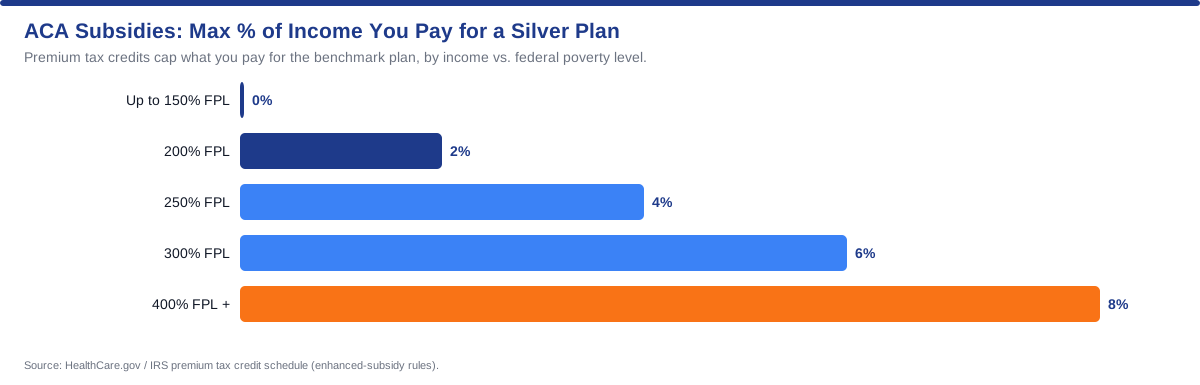
The Premium Tax Credit (PTC)
The PTC is a subsidy that lowers your monthly premium on a marketplace plan. It's calculated so that coverage costs a fixed percentage of your household income (the "expected contribution"), scaled by income tier. The lower your income (within the eligible range), the larger the credit. You can take it upfront as a lower monthly bill or as a refundable credit at tax time — but taking it upfront means reconciling it on your return, so big income swings can create a true-up.
Who Qualifies
Eligibility hinges on modified adjusted gross income (MAGI) and household size, and on not having access to affordable employer coverage or being eligible for Medicare/Medicaid. Households with income between 100% and 400% of the federal poverty level have long qualified; recent expansions have removed the upper cap for many years, so even higher earners without workplace options may now receive help. The only way to know your exact credit is to apply through the marketplace with your income estimate.
Cost-Sharing Reductions (CSR)
Separate from the premium credit, CSRs lower your out-of-pocket costs — deductibles, copays, and coinsurance — on a Silver plan. They're available only to those with income up to 250% of the poverty level, and they make a Silver plan behave more like a Gold or Platinum one for cost sharing. Crucially, you must pick a Silver plan to get CSRs; a Bronze or Gold plan won't unlock them even if you qualify.
Metal Tiers and the Subsidy Interaction
| Tier | Typical actuarial value | Best fit |
|---|---|---|
| Bronze | ~60% of costs | Low premium, healthy, rare use |
| Silver | ~70% (more with CSR) | Balanced; required for CSR |
| Gold | ~80% of costs | Higher use, predictable costs |
| Platinum | ~90% of costs | High use, max predictability |
Estimating Your Subsidized Premium
Your subsidized premium depends on three inputs: your income estimate, household size, and the plan's full price in your area. The marketplace does the math, but you can sanity-check it: if your expected contribution is, say, 6% of income and the benchmark Silver plan costs $500/month, your credit covers the difference. Always enter a realistic income — underestimating triggers a smaller credit now but a repayment later; overestimating means a smaller advance credit but a refund at tax time.
Common Mistakes
- Assuming you earn too much — the expanded caps mean many higher earners now qualify.
- Picking Bronze when you qualify for CSR — you forfeit cost-sharing help you've earned.
- Guessing income wildly — the true-up at tax time can surprise you.
- Ignoring the marketplace because you assume employer coverage is cheaper — compare both.
Reconciling the Subsidy at Tax Time (Form 8962)
If you take the premium tax credit in advance - as a lower monthly bill - you must reconcile it on your federal return using Form 8962. The IRS compares the credit you received to the credit you were actually eligible for based on your final income. If your income came in lower than estimated, you'll get the difference as a refund; if it came in higher, you may repay some or all of the excess, though annual repayment caps protect lower-income households from owing the full amount. The key habit: report income changes to the marketplace during the year, not just at tax time, so the advance credit tracks reality and the true-up stays small.
The Family Glitch and Its 2023 Fix
For years, the "family glitch" left many families without help: affordability of employer coverage was judged by the cost for the employee alone, so even a wildly expensive family plan was deemed "affordable," blocking marketplace subsidies for spouses and kids. A 2023 rule fixed this by judging affordability based on the cost of family coverage. Now, if the employer's family premium exceeds the affordability threshold, family members can qualify for marketplace subsidies instead. If you were previously denied help because of a workplace family plan, it's worth re-checking your eligibility.
Medicaid Expansion and the Coverage Gap
The ACA envisioned states expanding Medicaid to adults with income up to 138% of the poverty level, with the federal government covering most of the cost. States that didn't expand left a "coverage gap": residents earning too much for Medicaid yet too little to qualify for marketplace credits (below 100% of poverty) may have no affordable option at all. If you're in that range, check your state's specific rules and any state-specific programs - and note that the subsidy math in this article assumes you live where expansion applies. Eligibility is genuinely state-dependent.
Special Enrollment Periods After a Life Event
You don't have to wait for the annual open enrollment to get covered or change plans. Qualifying life events - losing other coverage, getting married, having a baby, moving, or a change in income that affects eligibility - trigger a Special Enrollment Period of roughly 60 days to sign up. Missing that window can mean waiting until the next open enrollment, so act quickly when a life event occurs. For income-driven subsidy changes, you can often update your application mid-year and adjust your advance credit immediately rather than waiting for tax season.
A Worked Subsidy Example
| Item | Value |
|---|---|
| Household income (1 person) | $28,000 |
| Benchmark Silver plan premium | $500/mo |
| Expected income contribution (~8.5%) | $199/mo |
| Premium tax credit | $301/mo |
| Your net premium | $199/mo |
At this income, the credit covers roughly 60% of the benchmark premium. Because the credit is tied to the benchmark, choosing a cheaper Bronze plan could lower your net cost further, while a Gold plan would cost more out of pocket - the subsidy math rewards informed shopping.
Estimating Income When You're Self-Employed
Self-employed households estimate income from profit (revenue minus business expenses), not gross revenue - a common and costly mistake that overstates income and shrinks the credit. Use a realistic projection for the coverage year, leaning on the prior year's Schedule C as a baseline and adjusting for known changes. Because self-employment income swings, report changes to the marketplace promptly when a good or bad year materializes, so your advance credit stays accurate and the tax-time true-up stays small. If your income ends the year far above the estimate, you may repay some credit; if below, you'll receive the difference as a refund.
The Subsidy and the Medicaid Line
Subsidies and Medicaid are different programs that meet at the poverty line. Below 100% of the federal poverty level in an expansion state, Medicaid (not a marketplace subsidy) is usually the pathway; above it, the premium tax credit applies. The marketplace routes you to the right one when you apply, but you should understand the boundary: a small income change near that line can move you between the two, changing your costs and your network of providers. If your income is close to the Medicaid threshold, report changes immediately so you're in the correct program and don't face a gap or an unexpected bill.
Off-Marketplace Plans and Subsidies
You can buy health insurance directly from an insurer or a broker outside the marketplace, but doing so generally forfeits the premium tax credit - the subsidy only applies to plans purchased through HealthCare.gov or a state exchange. Some off-marketplace plans look cheaper up front yet cost far more once you add the lost credit. The exception is special streamlined enrollment through an employer or government program. For most subsidy-eligible households, the marketplace is the only place the credit is applied; shopping there first, then comparing, is the way to see your true net price.
What If Your Income Drops Mid-Year?
A mid-year income drop is good news for your subsidy. Update your application on the marketplace as soon as the change happens: your expected contribution falls, your premium tax credit rises, and your advance credit (your lower monthly bill) increases immediately. You don't have to wait until tax time to benefit - reporting the drop promptly puts more help in your pocket right away. Conversely, a mid-year income rise should also be reported so you don't face a large repayment at reconciliation. The marketplace is built for these updates; using them keeps your coverage affordable through real-life income swings instead of leaving money on the table or creating a surprise bill.
Related Articles
How to Choose an Insurance Company
Compare financial strength and complaints
Switch Insurance Companies
Move coverage without a lapse
How Much Life Insurance
DIME and human-life-value methods
Deductible vs. Premium
The trade-off that sets your cost
Explore State Guides
California Insurance
Local rates & requirements
Texas Insurance
Local rates & requirements
Florida Insurance
Local rates & requirements
Frequently Asked Questions
Eligibility depends mainly on your household MAGI relative to the federal poverty level, your household size, and whether you have access to affordable employer or government coverage. The definitive answer comes from applying at the federal or state marketplace with your income estimate — there's no cost to check, and many people who assume they earn too much actually qualify.
The premium tax credit lowers your monthly bill; cost-sharing reductions lower your deductibles and copays when you actually use care. CSRs are only available on Silver plans and only to lower-income enrollees, while the premium credit can apply across metal tiers.
If you take the credit in advance and your actual income ends up higher than estimated, you may repay some or all of the excess at tax time, subject to annual caps for lower-income households. Estimating income as accurately as possible, and reporting changes mid-year, keeps the true-up small.
Because Silver is the only tier that unlocks cost-sharing reductions for qualifying households — it effectively raises the plan's actuarial value, lowering your out-of-pocket costs. If you qualify for CSR, a Silver plan often delivers better real-world value than a more expensive Gold plan.
Yes, if your employer coverage is considered unaffordable (generally above a set percentage of household income for self-only coverage) or doesn't meet minimum value. Otherwise the marketplace subsidy isn't available, but you can still shop there at full price. Compare your employer offer against a marketplace quote to see which is better.
Related Tools
Health Insurance Calculator
Estimate ACA marketplace premium
Life Insurance Calculator
Estimate your life insurance cost
How to Choose a Company
Compare insurers on evidence
Data sources: HealthCare.gov, Centers for Medicare & Medicaid Services (CMS). Last updated: July 2026. This article is original editorial content for educational purposes and does not constitute tax or insurance advice; use the official marketplace for your exact eligibility.