The deductible and the premium are two sides of the same decision: how much risk you keep versus how much you hand to the insurer. Lower your deductible and your premium rises; raise your deductible and your premium falls. The "right" balance isn't about being brave or cautious — it's about matching the deductible to cash you can actually access, and only raising it as far as the premium savings justify.
Model the Trade-Off Yourself
See how different deductibles shift your estimated premium before you commit.
Open the Auto Insurance Calculator →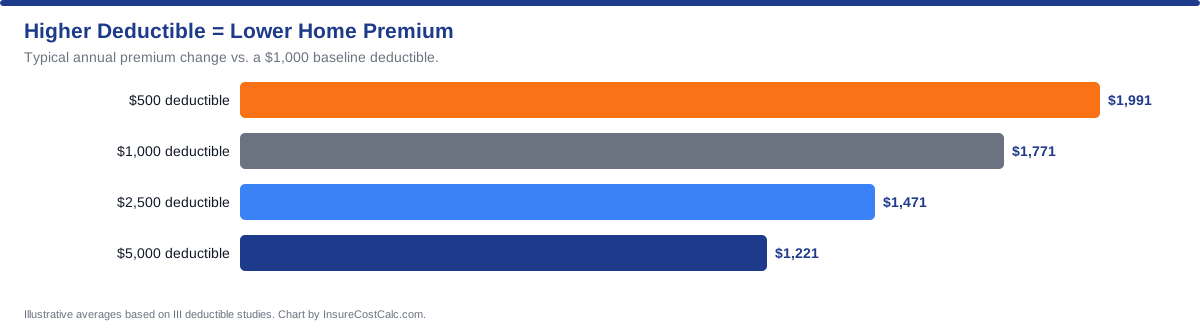
What Each Term Means
Your premium is the price of the policy — what you pay whether or not you ever file a claim. Your deductible is what you pay out of pocket on each claim before the insurer pays the rest. If a $10,000 loss has a $1,000 deductible, you receive $9,000. The deductible is your retained risk; the premium is the price of transferring the rest.
The Break-Even Math
Raising a deductible from $500 to $1,000 might cut your premium by $120/year. To "recover" that higher deductible, you'd need to avoid a claim for about four years ($500 ÷ $120 ≈ 4.2 years) for the savings to exceed the extra $500 you'd pay on the first claim. If you file a claim this year, the lower deductible would have saved you money. The decision hinges on your claim frequency: people who rarely claim should lean toward higher deductibles; people with frequent small losses should keep deductibles low.
Match the Deductible to Your Emergency Fund
The only rule that overrides all others: never set a deductible higher than you could pay from savings on a bad day. A $5,000 deductible that saves $200/year is a poor trade if a claim would force you onto a credit card at 25% interest. The deductible should sit comfortably inside your emergency fund, not above it. If you don't have the cash, a lower deductible is the cheaper real-world choice even at a higher premium.
Different Perils, Different Deductibles
Home policies often stack multiple deductibles: an "all-peril" deductible for most losses, plus a separate wind/hail or hurricane deductible (often 1%–5% of dwelling) in storm-prone regions, and sometimes a separate earthquake deductible. Auto policies usually have one collision and one comprehensive deductible. When comparing quotes, compare the same deductibles — a quote that dropped the hurricane deductible to 1% from 5% isn't cheaper; it's different coverage.
A Worked Example
| Deductible | Annual premium | Extra out-of-pocket at claim | Break-even vs $500 |
|---|---|---|---|
| $500 | $1,400 | $500 | — |
| $1,000 | $1,220 | $1,000 | ~4 years |
| $2,500 | $1,010 | $2,500 | ~7 years |
Above roughly $2,500, the marginal premium savings often shrink while the out-of-pocket exposure grows large — a sign you've raised the deductible past the sensible point for most households.
Common Mistakes
- Setting the deductible above your savings — the "savings" vanish the moment you can't pay the claim.
- Chasing a tiny premium drop for a huge deductible jump.
- Forgetting separate peril deductibles on home policies.
- Raising the deductible but not actually banking the difference — if the savings go to spending, you've taken on risk for no buffer.
How a Higher Deductible Changes Your Risk Behavior
Raising your deductible isn't just an accounting move - it changes how you use insurance. People with a low deductible tend to file claims for small losses ("the insurer will cover it"), which can push their rates up over time and clutter their claims history. People with a high deductible self-insure the small stuff and reserve insurance for genuine emergencies, which keeps their record clean. That behavioral effect is part of why insurers price high-deductible policies lower: they expect fewer claims. The right deductible aligns with how disciplined you'll actually be about filing.
A Full Side-by-Side: $500 to $5,000
| Deductible | Annual premium | Extra at first claim | Break-even |
|---|---|---|---|
| $500 | $1,400 | $500 | - |
| $1,000 | $1,220 | $1,000 | ~4 yrs |
| $2,500 | $1,010 | $2,500 | ~7 yrs |
| $5,000 | $880 | $5,000 | ~11 yrs |
Past about $2,500 the premium savings flatten while your out-of-pocket risk climbs steeply. For most households the sweet spot sits between $1,000 and $2,500, paired with a funded emergency account.
When a Low Deductible Actually Makes Sense
The high-deductible advice assumes you can absorb the hit and avoid small claims. That isn't everyone. If you have minimal savings, a chronic condition that raises loss frequency, or a history of frequent small claims, a lower deductible is the rational choice - you're paying the insurer to smooth volatility you can't smooth yourself. Likewise, if the premium drop between deductibles is tiny (often true above $2,500), the "savings" isn't worth the exposure. The right deductible is the highest one you could pay from savings on the worst day of the year, not the one that simply looks cheapest on the quote.
Pair a High Deductible With a Savings Buffer
The textbook way to "self-insure" the deductible is to bank the premium you no longer pay. If raising your deductible saves $190/year, route that $190 into a dedicated savings bucket. After a few claim-free years, that bucket can cover the deductible outright - at which point the higher deductible has made you money without ever costing you a claim. The mistake is spending the savings: then you've taken on risk with no buffer, which defeats the strategy entirely.
Bundled-Policy Deductible Traps
When home and auto are bundled, deductibles are quoted separately and easy to overlook. A bundle might carry a $1,000 all-peril home deductible, a 2% hurricane deductible, a $500 auto collision deductible, and a $250 comprehensive deductible - four different numbers applying to four different losses. Confirm each one on the dec page, and make sure none exceeds what you could pay from savings on a bad day. A bundle discount that hides an unaffordable deductible is no bargain.
Deductibles and the Post-Claim Surcharge
Filing a claim doesn't just cost the deductible - it can raise your premium at renewal through a claims surcharge. This interacts with your deductible choice: a low deductible tempts you to file small claims, each of which adds a surcharge, while a high deductible discourages small claims and keeps your record cleaner. Over several years, the surcharge from a couple of minor claims can exceed the deductible savings you thought you gained. The lesson compounds the earlier point: the deductible you choose shapes your claims behavior, and your claims behavior shapes your price. A high deductible isn't only about the math of one loss; it's about avoiding the surcharges that follow repeated small ones.
Choosing a Deductible by Policy Type
The right deductible differs by line. On auto collision, a $500-$1,000 deductible is common and pairs well with a healthy emergency fund. On auto comprehensive (theft, glass, weather), a lower deductible can make sense because these losses are frequent and small. On homeowners, the all-peril deductible is often $1,000-$2,500, with separate percentage deductibles for wind/hail. On renters, deductibles are usually $500-$1,000 because contents claims are smaller. There's no single "right" number - set each line's deductible to what you could actually pay from savings for that type of loss, rather than copying one figure across policies.
The Deductible on a Replacement-Cost Policy
On a replacement-cost home policy, the deductible applies to the total loss before any cost basis is considered - it's subtracted from the claim whether you're paid actual cash value first or replacement cost. What changes with replacement cost is the recoverable depreciation, not the deductible. A common confusion: people think a higher deductible also reduces the depreciation they recover. It doesn't. The deductible is a fixed amount off the top; the depreciation holdback is separate and returned once you repair. Understanding this prevents the false belief that raising the deductible somehow shrinks your net recovery beyond the stated dollar amount.
A Quick Way to Decide Your Deductible
If you want a single rule: set each deductible to the largest amount you could pay from savings on the worst day of a typical claim year, then confirm the premium saving for going higher is meaningful (roughly $100+/year). If raising the deductible saves only $30 but exposes you to $2,000 more at claim time, keep it low. If it saves $200 and you could cover the higher out-of-pocket from your emergency fund, raise it. Write the chosen numbers next to each policy in your records so you're not re-deciding under stress after a loss. The decision is personal, not universal - it follows your savings, not the insurer's preference or the cheapest-looking quote.
Related Articles
What Is Homeowners Insurance
Coverage, perils, and policy structure
Read Your Declarations Page
Decode your policy summary
Bundle Home & Auto
When combining policies saves or costs
How Much Life Insurance
DIME and human-life-value methods
Explore State Guides
Florida Insurance
Local rates & requirements
Texas Insurance
Local rates & requirements
California Insurance
Local rates & requirements
Frequently Asked Questions
No. A higher deductible only pays off if you can afford it at claim time and if you avoid claims long enough for the premium savings to exceed the extra out-of-pocket cost. For someone with little savings or frequent small losses, a lower deductible is the smarter, cheaper real-world choice.
Moving from $500 to $1,000 on auto insurance commonly cuts the collision and comprehensive portion of the premium by 15–30%, and home-insurance savings are similar in proportion. The exact figure varies by state, insurer, and risk profile, so model it on a calculator before deciding.
Some home policies apply a percentage deductible (often 1%–5% of the dwelling limit) to wind, hail, or hurricane losses instead of a flat dollar amount. On a $400,000 home, a 2% hurricane deductible means $8,000 out of pocket for that peril. These are separate from your standard all-peril deductible.
Ideally, yes — the premium you stop paying should land in savings so you can actually cover the higher deductible if a claim arrives. If the savings are spent elsewhere, you've taken on more risk without building the buffer to absorb it, which defeats the purpose.
Almost always per claim, not per year. Each separate loss typically triggers the deductible again. Some policies offer a "disappearing" or aggregate deductible that reduces after claim-free years, but the standard structure is one deductible per incident.
Related Tools
Car Insurance Calculator
Estimate your monthly premium
Home & Renters Calculator
Estimate home insurance cost
Umbrella Calculator
Estimate liability umbrella cost
Data sources: NAIC, Insurance Information Institute (III). Last updated: July 2026. This article is original editorial content for educational purposes and does not constitute insurance advice; consult a licensed agent for your specific situation.