Homeowners insurance is a package policy: it protects the physical structure of your home, your belongings, your living expenses if you're displaced, and your liability if someone is hurt on your property. Understanding the six standard coverages — and the gaps they leave — is the difference between a policy that pays and one that surprises you at claim time.
Estimate Your Homeowners Insurance Cost
Start with a personalized estimate, then read on to tune the coverage behind the price.
Open the Home & Renters Calculator →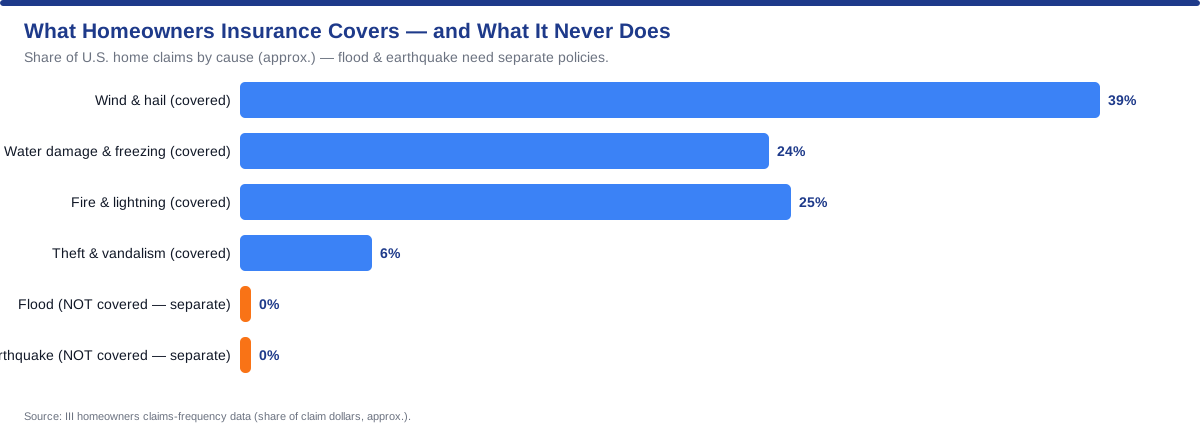
The Six Standard Coverages (HO-3)
A standard HO-3 policy — the most common form — bundles six coverages. The first is "open perils" (covers all causes except those explicitly excluded), while the remaining property coverages are typically "named perils" (covered only for the causes listed).
1. Dwelling Coverage (Coverage A)
Protects the physical structure — walls, roof, foundation, built-in appliances, and attached structures — against covered perils such as fire, wind, hail, and vandalism.
Example: A kitchen fire causes $40,000 in damage. Dwelling coverage pays to rebuild it, minus your deductible. Set this limit to the full rebuild cost, not the market price.
2. Other Structures (Coverage B)
Covers detached buildings: garage, shed, fence, gazebo, and sometimes a detached studio. Typically defaults to about 10% of Coverage A, and you can raise it if you have extensive outbuildings.
3. Personal Property (Coverage C)
Protects belongings — furniture, electronics, clothing, appliances — anywhere in the world. Usually 50–70% of Coverage A. Tip: keep a home inventory (photos or an app) so a claim isn't a guessing game. High-value items like jewelry or art often need a scheduled endorsement with separate limits.
4. Loss of Use (Coverage D)
Pays additional living expenses — hotel, meals, storage, temporary rent — if a covered event makes your home uninhabitable during repairs. Limits are usually a percentage of Coverage A or a time-based cap.
5. Personal Liability (Coverage E)
Protects you if someone is injured on your property (or you're responsible for damage elsewhere) and sues. Covers legal defense, medical bills, and settlements. Most advisors recommend at least $300,000–$500,000, with an umbrella policy on top if your assets are larger.
6. Medical Payments (Coverage F)
Covers minor medical costs for guests injured on your property, regardless of fault, with no lawsuit required. Typical limits run $1,000–$5,000 and it's an inexpensive way to settle small incidents before they escalate.
Replacement Cost vs. Actual Cash Value
This distinction drives most claim disputes. Replacement cost (RC) pays to rebuild with like materials at today's prices, with no deduction for depreciation. Actual cash value (ACV) pays the depreciated value — an old roof might be valued at a fraction of its replacement cost. Most HO-3 policies cover the dwelling at RC but personal property at ACV unless you add "replacement cost on contents," which is usually worth it. Always confirm which basis applies to each coverage.
What's NOT Covered (and the Fix)
Standard policies leave deliberate gaps. Knowing them lets you buy the right endorsement before you need it:
- Flood — requires separate flood insurance (NFIP or private).
- Earthquake — requires a separate endorsement or policy, common in quake-prone states.
- Water backup / sump overflow — add a cheap "water backup" endorsement.
- Sewer line / service upgrades — often excluded or capped; ask about an endorsement.
- Normal wear, pests, mold from neglect — maintenance is the owner's job, not the insurer's.
- High-value items — jewelry, art, collectibles need scheduling above the default sub-limits.
How Much Does It Cost, and Why?
National averages for homeowners insurance run in the low four figures per year, but the number swings dramatically by state, rebuild cost, and exposure. Premiums are built from the rebuild cost multiplied by a rate that reflects your risk profile.
Key cost drivers:
- Rebuild cost — square footage, construction type, and local labor/material costs.
- Location — wildfire, wind/hail, and crime exposure; coastal and fire-prone areas cost far more.
- Home age and systems — older roofs, wiring, and plumbing raise rates; updates earn credits.
- Coverage limits & deductible — higher limits cost more; a higher deductible lowers the premium.
- Claims history — prior claims follow you via CLUE reports.
- Credit-based insurance score — used in most states and strongly predictive.
How to Set the Right Limits
1. Insure to rebuild cost, not market value
Market value includes land, which doesn't burn. Insure for what it costs to rebuild the structure. A local builder's per-square-foot estimate or an insurance replacement-cost estimator is the right input.
2. Choose a deductible you can fund
Common deductibles are $500, $1,000, or $2,500. Higher deductibles cut premiums, but keep the difference in savings so a claim doesn't hurt. In catastrophe-prone areas, separate wind/hail or hurricane deductibles may apply as a percentage of Coverage A.
3. Add an umbrella if assets are exposed
If your net worth exceeds your liability limit, a personal umbrella policy adds $1M+ of liability protection for modest annual cost.
4. Shop at least three carriers
Rates vary widely for identical coverage. Match limits and deductibles exactly, and check the financial strength ratings (A.M. Best, S&P) and complaint ratios (your state DOI publishes them) — a cheap policy from a weak payer isn't a bargain after a catastrophe.
The Claims Process, Briefly
When a loss occurs: document everything with photos, prevent further damage (reasonable temporary repairs), notify your insurer promptly, and keep receipts for any emergency spending. An adjuster assesses the damage; payment is issued minus your deductible and subject to your coverage basis (RC vs ACV). A clear home inventory dramatically speeds personal-property settlements.
Renters: You Need Coverage Too
A renters policy is essentially Coverages C, D, E, and F without the dwelling — it protects your belongings, liability, and temporary living costs for a fraction of a homeowners premium. If you rent, our home & renters calculator estimates both.
Choosing the Right Policy Form
Not every homeowners policy is an HO-3. The form you need depends on whether you own or condo/co-op, and how broad you want coverage to be:
- HO-2 (broad form): dwelling covered on a named-perils basis — cheaper but narrower.
- HO-3 (special form): the standard default — open perils on the dwelling, named perils on contents.
- HO-5 (comprehensive): open perils on both dwelling and contents — broader, usually costlier, best for higher-value homes.
- HO-6 (condo): covers your unit's interior and personal property; the association's master policy handles the shell.
- HO-4 (renters): no dwelling coverage, just contents + liability + loss of use.
If you own a newer or high-value home, ask whether HO-5 is available — the broader "open perils" basis on your belongings removes many disputes about whether a cause was "named."
Endorsements Worth Considering
Endorsements customize a base policy. Commonly valuable ones:
- Replacement cost on contents — switches belongings from ACV to RC.
- Extended or guaranteed replacement cost — pays 120–150% (or more) of Coverage A if rebuild costs spike after a widespread disaster.
- Water backup & sump overflow — inexpensive and frequently used.
- Service line coverage — repairs to buried utility lines on your side of the meter.
- Scheduled personal property — raises sub-limits on jewelry, art, and electronics.
- Ordinance or law coverage — pays the extra cost of bringing an older home up to current building codes during a rebuild.
How a Premium Is Built (Illustrative)
The numbers below are illustrative to show how limits and deductibles move the price — your real quote depends on location, home, and history. They are not a rate quote.
| Scenario | Coverage A | Deductible | Relative annual cost |
|---|---|---|---|
| Modest home, basic limits | $250k | $1,000 | Baseline |
| Same home, higher deductible | $250k | $2,500 | Lower |
| Larger rebuild cost | $450k | $1,000 | Higher |
| High-value + umbrella | $600k | $1,000 | Highest (plus umbrella) |
Mistakes to Avoid When Buying
- Insuring to market value — you pay for land you don't need to rebuild.
- Assuming flood is included — it never is, in any standard form.
- Skipping the home inventory — claims stall without proof of belongings.
- Choosing the cheapest deductible blindly — a $500 deductible raises the premium; match it to your savings.
- Ignoring the insurer's financial strength — after a regional catastrophe, claim-paying ability matters most.
Your State Changes the Baseline
Catastrophe exposure and regulatory environment differ enormously by state, which is why a Florida or Louisiana premium looks nothing like an Oregon one. Our state insurance guides detail the dominant risk and typical cost drivers where you live.
How to File a Claim Smoothly
When a covered loss occurs, act fast and document everything. Photograph the damage before any temporary repairs, and keep receipts for emergency fixes you make to prevent further loss — those costs are often reimbursable. Notify your insurer promptly, and expect an adjuster to assess the damage; for larger claims they may scope the work with a contractor. A current home inventory and records of major upgrades (a new roof, remodeled kitchen) materially speed the settlement and support your claimed amounts.
Related Articles
Renters Insurance Guide
Protect your belongings affordably
Bundle Home & Auto
When combining policies saves or costs
Deductible vs. Premium
The trade-off that sets your cost
The Insurance Claims Process
Step-by-step from filing to payout
Explore State Guides
Florida Insurance
Local rates & requirements
Texas Insurance
Local rates & requirements
California Insurance
Local rates & requirements
Frequently Asked Questions
No state law requires it, but if you have a mortgage your lender will require it (and often escrow the premium). Even with no mortgage, dropping it risks your largest asset; the protection is usually far cheaper than the rebuild cost you'd otherwise pay out of pocket.
A practical rule: (1) Coverage A = full rebuild cost, (2) Coverage C = 50–70% of A (more if you own valuable belongings), (3) liability at least $300,000, and (4) an umbrella policy if your assets exceed that. Also choose replacement-cost basis on contents rather than ACV.
No. Standard homeowners policies exclude both. Flood insurance is purchased separately through the National Flood Insurance Program or private markets; earthquake coverage is a separate endorsement or policy. If you're in a high-risk zone, budget for these explicitly.
Replacement cost pays to rebuild at current prices with no depreciation deduction; actual cash value pays the depreciated value. The difference can be tens of thousands on a roof or entire structure. Confirm which basis applies to your dwelling and your contents.
Often, yes — especially liability or large property claims, which are recorded in a CLUE report that future insurers see. Small, frequency claims (multiple minor water claims) hurt more than one large unforeseen loss. That's why a higher deductible andprompt maintenance can be cheaper long-term than filing every small claim.
Related Tools
Home & Renters Calculator
Estimate your premium
Flood Insurance Calculator
Check your flood exposure
Umbrella Insurance Calculator
Calculate extra liability
Data sources: National Association of Insurance Commissioners (NAIC), Insurance Information Institute (III). Last updated: June 2026. This article is original editorial content for educational purposes and does not constitute insurance advice; consult a licensed agent for decisions specific to your situation.