What ACA Marketplace Insurance Is
The Affordable Care Act created state-based marketplaces (some run by states like Covered California or NY State of Health, the rest by Healthcare.gov) where individuals and families buy private plans with standardized benefits and, for many households, government subsidies. Every marketplace plan covers ten essential health benefits — including preventive care with no cost-sharing, emergency services, hospitalization, prescription drugs, and maternity care — regardless of metal level.
How This Calculator Estimates Your Premium
The estimator uses the factors that actually set your marketplace price: household size, household income (which drives any subsidy), the oldest applicant's age, the metal level, your state, and tobacco use. It returns a gross premium, the estimated premium tax credit, your net "you pay" amount, and an annual family maximum. Because subsidies are tied to the cost of the second-lowest-cost Silver plan in your area, the income input is the single most powerful lever in the tool.
How the Subsidy (Premium Tax Credit) Works
The premium tax credit caps what you pay for a benchmark Silver plan at a percentage of income that scales with the Federal Poverty Level. Lower incomes pay a smaller share; higher incomes pay more, phasing out as income rises. Households with income between 100% and 400% of the FPL have long qualified, and expanded eligibility (with the cap tied to income rather than a hard cutoff) has extended help to many middle-income families as well. The credit can be taken upfront to lower monthly bills or claimed on your tax return.
Choosing a Metal Level
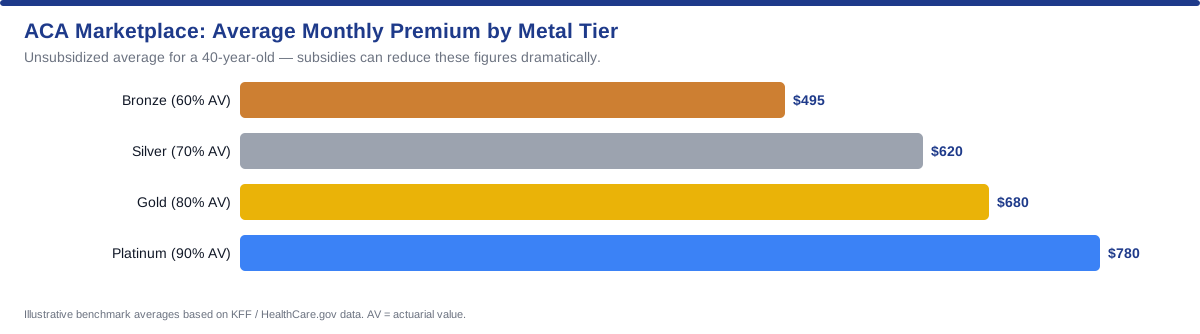
Metal levels describe cost-sharing, not quality: Bronze (≈60% paid by the plan) has the lowest premium and highest out-of-pocket — best if you rarely use care. Silver (≈70%) is the default for most and is the only level that unlocks cost-sharing reductions for lower incomes. Gold (≈80%) and Platinum (≈90%) cost more monthly but pay more per claim — often worth it if you expect significant medical expenses.
Marketplace vs. Employer Coverage
If you have access to "affordable" employer coverage (generally defined as costing less than roughly 9.5% of household income for self-only coverage), you usually can't claim a marketplace subsidy. The marketplace matters most for the self-employed, early retirees, gig workers, and anyone whose employer doesn't offer coverage. Always compare both paths before deciding.
Methodology and Assumptions
This tool returns an educational estimate, not an enrollment decision or a bound quote. Actual premiums and subsidies depend on your exact ZIP code rating area, plan selection, household composition, and current federal rules, which change. Use it to understand the levers; confirm final numbers at Healthcare.gov or your state marketplace during open enrollment.
Reading Your Estimate
The calculator's key output is the gap between the gross premium and your net "you pay" amount — that gap is the subsidy. If "you pay" is close to the gross, your income is too high to qualify; if it's a fraction, the premium tax credit is doing heavy lifting. The annual family maximum is the out-of-pocket cap, which matters more than the premium for anyone expecting significant care.
Maximizing Your Subsidy
Because the credit is tied to income, small income changes near the eligibility edges move your price a lot. If you're self-employed, legal retirement contributions can lower your MAGI and increase your credit. If your income for the year ends up lower than estimated, you'll receive the extra credit at tax time; if it ends up higher, you may repay some — so estimate carefully and report income changes mid-year to avoid a surprise reconciliation.
Marketplace vs. Off-Exchange
On-exchange plans let you claim the premium tax credit; identical off-exchange plans from the same insurer don't. Unless you're certain you won't qualify for a subsidy, enroll through the marketplace. Short-term and indemnity plans are cheaper but aren't ACA-compliant, can exclude pre-existing conditions, and don't count as coverage — they're a poor substitute for most households.
Common Mistakes
- Buying the cheapest Bronze for ongoing needs: low premiums hide high out-of-pocket costs when you actually use care.
- Ignoring provider networks: a low price is worthless if your doctors aren't in-network.
- Missing open enrollment: outside it you generally need a qualifying life event.
- Forgetting the drug formulary: check that your prescriptions are covered before choosing.
A Sample Scenario
A family of four with $60,000 household income and a 40-year-old primary applicant might see a Silver plan gross premium around $1,300/month, with a premium tax credit bringing their net cost down to perhaps $200–$400/month depending on their state. Raise income to $90,000 and the credit shrinks, net cost climbs; drop to a Bronze plan and the net premium falls but copays rise. The calculator shows these trade-offs side by side.
🏥 Health Insurance Premium Estimator
Estimate your monthly health insurance premium and see if you qualify for ACA subsidies.
Related Articles
Health Insurance Subsidies
ACA premium tax credits explained
How to Choose an Insurance Company
Compare financial strength and complaints
Switch Insurance Companies
Move coverage without a lapse
How Much Life Insurance
DIME and human-life-value methods
Health Insurance FAQ
The ACA premium tax credit is a government subsidy that lowers your monthly health insurance premium. You qualify if: (1) Your income is 100%-400% of the Federal Poverty Level (though the American Rescue Plan expanded this to 0-600% temporarily through 2025), (2) You buy insurance through the ACA marketplace, (3) You don't have access to affordable employer coverage. Use our calculator to estimate your subsidy.
Metal levels indicate how much the plan pays vs. what you pay: Bronze: 60% paid by insurance, 40% by you (lowest premium, highest out-of-pocket). Silver: 70%/30% (moderate premium, qualifies for cost-sharing reductions if eligible). Gold: 80%/20% (higher premium, lower out-of-pocket). Platinum: 90%/10% (highest premium, lowest out-of-pocket). Most Americans choose Silver.
Open enrollment typically runs from November 1 to January 15 each year for coverage starting the following year. Some states with their own marketplaces (CA, NY, WA, etc.) have extended deadlines. You can enroll outside open enrollment if you have a Qualifying Life Event (marriage, birth of a child, loss of job-based coverage, move, etc.).
You generally must wait for the next open enrollment unless you experience a qualifying life event — marriage, birth or adoption, loss of other coverage, a move, or a substantial income change. Those events trigger a special enrollment period, usually 60 days, during which you can enroll or switch plans outside the normal window.
Yes. Under ACA rules, marketplace plans cannot deny coverage or charge more because of pre-existing conditions, and they must cover treatment for them. This protection is a core reason the marketplace exists; short-term and indemnity plans, which are not ACA-compliant, can still exclude them.
Only if your doctor is in the plan's network. HMO and EPO plans generally require you to use in-network providers except for emergencies, while PPO plans offer out-of-network coverage at a higher cost. Always check the plan's provider directory for your specific physicians and any facilities you regularly use before enrolling.
There is no longer a federal tax penalty for lacking health insurance, but a few states — including Massachusetts, New Jersey, California, Rhode Island, and D.C. — impose their own state-level individual mandates with penalties. Even where no penalty applies, going without coverage risks unaffordable medical bills, so the marketplace subsidy often makes coverage the cheaper choice.
Getting Covered: 5 Steps
- Estimate your income accurately. Your MAGI drives the subsidy, so use a realistic figure and report mid-year changes to avoid a tax-time reconciliation surprise.
- List your doctors and drugs. Before picking a plan, confirm your physicians are in-network and your prescriptions are on the formulary — a low premium is worthless if care isn't covered.
- Compare metals by total cost. Add premium plus expected copays and deductibles, not just the monthly price; Gold often beats Bronze for frequent users.
- Check subsidy eligibility. Run the calculator, then enroll through the marketplace (Healthcare.gov or your state exchange) so you can claim the premium tax credit.
- Mark the calendar. Enroll during open enrollment (roughly Nov 1–Jan 15) or after a qualifying life event; otherwise you may have to wait a year.
If you have affordable employer coverage, the marketplace subsidy usually won't apply — but for the self-employed, early retirees, and the uninsured, the marketplace is typically the best value available.
Key Takeaways
- Your subsidy hinges on income. The premium tax credit is tied to your MAGI, so estimate it accurately and report mid-year changes to avoid a repayment at tax time.
- Silver unlocks extra savings. Only Silver plans qualify for cost-sharing reductions, which can matter more than the premium for frequent users of care.
- Check network and formulary. A low premium is worthless if your doctors and prescriptions aren't covered — verify before enrolling.
- Employer coverage changes the math. If you have affordable workplace coverage, the marketplace subsidy usually won't apply; the marketplace matters most for the self-employed and uninsured.
Key Terms to Know
- Premium tax credit
- A government subsidy that lowers your monthly marketplace premium based on income.
- Actuarial value
- The share of costs a plan pays on average (Bronze 60%, Silver 70%, Gold 80%, Platinum 90%).
- Cost-sharing reduction
- Extra savings on deductibles and copays available only on Silver plans for lower incomes.
- Essential health benefits
- The ten benefit categories every marketplace plan must cover.
- Open enrollment
- The annual window (roughly Nov 1–Jan 15) when you can sign up without a qualifying event.
📎 You Might Also Need
Based on your health insurance calculation, you may also want to estimate these costs:
People Also Ask About Health Insurance
How much does ACA health insurance cost per month?
The benchmark silver plan averages about $450 per month before subsidies for a 40-year-old, but most enrollees qualify for premium tax credits that lower it significantly based on income and household size.
Am I eligible for a premium subsidy?
You generally qualify if your household income is between 100% and 400% of the federal poverty level and you don't have affordable employer coverage. Recent rule changes have expanded subsidy access for many middle-income households.
Can I keep my doctor on a marketplace plan?
It depends on the plan's provider network. Each ACA plan publishes a directory—verify your doctors and medications are in-network before enrolling, since out-of-network care is usually far more expensive.
Sources & References
Our health insurance estimates, premium figures, and subsidy explanations are built from publicly available regulatory data, industry research, and guidance from the National Foundation for Credit Counseling (NFCC) on budgeting for premiums. These figures are planning estimates only.
Links are provided for verification only. InsureCostCalc.com is not affiliated with, endorsed by, or sponsored by any government agency or organization listed above. See our full references list.