Life insurance exists for one purpose: replacing the financial value of your life to the people who depend on it. Too little leaves your family exposed; too much drains your budget for coverage you'll never claim. The right number is the gap between what your dependents would need if you were gone and what they already have. This guide walks the calculation.
Estimate Your Life Insurance Cost
See what a given amount of coverage would cost you per month.
Open the Life Insurance Calculator →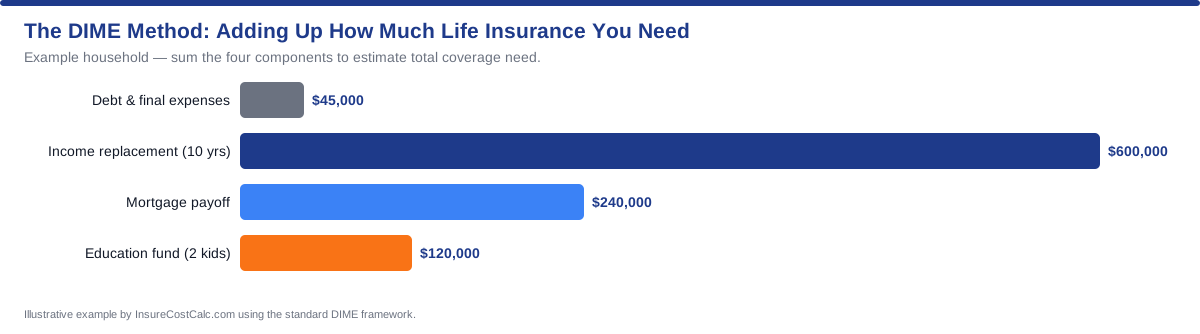
Start With the People Who Depend on You
If no one relies on your income — no children, no partner depending on your earnings, no aging parent you support — you may need little or no life insurance beyond perhaps a small policy to cover final expenses. The need scales with dependency. A sole earner with three kids needs substantially more than a dual-income couple with grown children and ample savings.
The DIME Framework
A simple way to size coverage is the DIME method, adding four buckets:
- Debt — mortgage balance, personal loans, credit cards you don't want passed to your family.
- Income — years of salary to replace (commonly 7–10× annual income for young families).
- Mortgage — often folded into debt, but some count the home payoff separately so the family keeps the house.
- Education — projected cost of college for each child.
Add those four and subtract your existing assets (savings, existing policies, college funds) to get the gap your new policy should fill.
A Worked Example
| Need component | Amount |
|---|---|
| Outstanding mortgage | $300,000 |
| Income replacement (10 × $60k) | $600,000 |
| Children's education | $150,000 |
| Other debts | $30,000 |
| Minus existing savings & policies | −$180,000 |
| Coverage gap | $900,000 |
Term vs. Whole Life
Term life covers a period (10, 20, 30 years) and is cheap because it pays only if you die within the term — ideal for covering the dependency years while children are young and the mortgage is large. Whole (permanent) life lasts a lifetime and builds cash value, but costs far more per dollar of coverage. For most families with a temporary need, level term matched to the dependency window is the efficient choice; permanent life suits specific estate or business-planning goals, not basic income replacement.
Common Sizing Mistakes
- Buying a round number with no method — "a million sounds like enough" ignores your actual gap.
- Counting only the mortgage — leaves income and education uncovered.
- Over-buying whole life for a need term life covers more cheaply.
- Forgetting to update after a new child, home, or job change.
Life Insurance Needs by Life Stage
The "right" amount shifts dramatically across a lifetime. A single young adult with no dependents usually needs only a small final-expenses policy, if any. A new parent needs a large policy to replace decades of income and fund college. Empty-nesters with grown, independent children and a paid-off home may need far less - often just enough to cover final expenses and any remaining debts. A business owner may need policies tied to buy-sell agreements or key-person protection. Revisit the amount at each stage rather than buying once and forgetting; needs fall as dependents become self-sufficient.
The Human-Life-Value (HLV) Method
Besides DIME, some planners use the Human Life Value approach: estimate the present value of your future earnings that dependents would lose. Take your after-tax income, subtract what you spend on yourself, and discount that "dependency income" back over your working years. A 35-year-old earning $80,000 with $25,000 of personal spending has $55,000 of dependency income; over 25 working years that's well over $1 million in today's dollars. HLV and DIME often land in the same ballpark and together give confidence the number is right. Use both and pick the more conservative.
How Much Is Too Much - or Too Little
Two guardrails help. Too little shows up as a policy that covers the mortgage but not the income years - the family keeps the house but can't maintain their lifestyle. Too much drains the budget on premiums for a risk that has shrunk; a couple with no kids and ample investments rarely needs ten times salary. A reasonable check: the death benefit should replace your dependents' income gap until they're self-sufficient, cover known debts, and leave a modest education fund - nothing more, nothing less. If a quote feels unaffordable, term life at a longer duration but lower face amount beats permanent life at a price you'll lapse.
Special Cases: Stay-at-Home Parents and Minor Children
A non-working spouse still needs coverage. The value of childcare, transportation, cleaning, and household management is real money - replacing it costs tens of thousands a year, and a stay-at-home parent's death imposes those costs on the surviving parent. Size that policy to the cost of the services lost. For minor children who are beneficiaries, the proceeds typically can't be paid directly to a minor; they flow to a guardian or a trust (often a uniform transfers-to-minor Act custodianship or a dedicated life insurance trust). Naming a trustee ensures the money is used as intended rather than locked in court-supervised oversight.
Laddering to Lower the Cost
If a large policy feels expensive, consider laddering: buy several term policies that expire as your need falls. For example, a $500,000 30-year term (covers the mortgage and young children), plus a $300,000 20-year term (covers the heavy child-rearing years), plus a $200,000 10-year term (covers the peak dependency window). As each expires, your obligations have shrunk, so you're not paying for coverage you no longer need. Laddering can cut total premium versus one large level policy, though it adds a little administrative complexity.
A Second Worked Example (Dual-Income Family)
| Need component | Amount |
|---|---|
| Mortgage payoff (joint) | $420,000 |
| Income replacement - both earners (8 x $90k combined) | $720,000 |
| Two children's education | $200,000 |
| Existing 401(k) & savings | -$260,000 |
| Combined gap | $1,080,000 |
Split across both spouses' policies in proportion to their income, this structure protects the family whether one or both earners are lost - a more resilient design than a single large policy on one parent.
Term Length: 10, 20, or 30 Years?
Match the term to how long the dependency lasts. A 30-year term suits a young parent with a newborn and a 30-year mortgage - it covers the entire window. A 20-year term fits a family with school-age children nearing independence. A 10-year term may suit someone close to retirement with a shrinking need. Longer terms cost more per year but lock in insurability while you're younger and healthier; shortening the term lowers the premium but risks needing to re-qualify later when rates and health may have changed. The efficient choice is the shortest term that still covers your dependency window, reviewed as that window shrinks.
Do You Need a Policy on Your Children?
Children rarely need their own life insurance - they have no income to replace, and the family's need is the parents' coverage, not the child's. The main exceptions: a small whole-life policy some parents buy to lock in insurability and build modest cash value for a child with a future health condition, and final-expenses coverage where cultural or estate reasons apply. Resist the pitch that a child "needs" large coverage; prioritize the parents' policies first. Once the parents are fully covered for the family's dependency need, a modest child policy is a personal choice, not a financial necessity.
Converting Term to Whole Life
Many term policies include a conversion option - the right to exchange the term policy for a permanent one without new medical underwriting, usually before a specified age or policy anniversary. This matters if your health declines and you still need coverage after the term ends; conversion preserves insurability you might otherwise lose. Permanent coverage costs substantially more, so convert only if the need has become permanent (e.g., a lifelong dependency) rather than temporarily. Check your policy's conversion window now, while you're healthy, so the option is available if a future diagnosis would otherwise make new coverage unaffordable or unavailable.
Where to Buy Term Life
Term life is sold directly by insurers, through independent brokers who compare carriers, and occasionally through employers as a group benefit (often the cheapest and easiest, though it usually ends when you leave the job). For an individual policy, an independent broker or a comparison of several direct carriers lets you see real price differences for the same coverage amount and term. Price varies widely by carrier for the same person, so quoting at least three is worthwhile. Once approved, lock the policy in force before cancelling any existing coverage - and revisit the amount at each life stage rather than treating the first policy as permanent. The product is simple; the shopping is where the savings are.
Related Articles
How to Choose an Insurance Company
Compare financial strength and complaints
Switch Insurance Companies
Move coverage without a lapse
Deductible vs. Premium
The trade-off that sets your cost
Health Insurance Subsidies
ACA premium tax credits explained
Explore State Guides
New York Insurance
Local rates & requirements
California Insurance
Local rates & requirements
Texas Insurance
Local rates & requirements
Frequently Asked Questions
A common rule of thumb is 7 to 10 times annual income for a young family with dependents, but that's a starting point, not a final answer. The DIME method — adding debts, income years, mortgage, and education, then subtracting existing assets — produces a number tailored to your situation rather than a generic multiple.
Often not for income replacement — but a small policy can still cover final expenses and any debts co-signed by a parent or partner. If no one depends on your income and you have no co-signed obligations, the need is minimal.
For most families covering a temporary dependency need, level term life is far more efficient — it delivers the most coverage per premium for the years it's needed. Whole life's cash value and lifetime coverage suit specific estate or business-planning aims and come at a much higher cost per dollar of protection.
Usually yes, even if one spouse earns less or not at all — the value of a stay-at-home parent's childcare, transportation, and household work is real, and replacing it costs money. Size each policy to the dependency each spouse's absence would create.
At every major life event: marriage, a child, a home purchase, a significant raise, or a divorce. Needs shrink as the mortgage falls and children become independent, and grow when new dependents arrive. Re-evaluating every few years keeps the amount aligned with reality.
Related Tools
Life Insurance Calculator
Estimate your life insurance cost
Home & Renters Calculator
Estimate home insurance cost
Umbrella Calculator
Estimate liability umbrella cost
Data sources: NAIC, Insurance Information Institute (III), American Council of Life Insurers (ACLI). Last updated: July 2026. This article is original editorial content for educational purposes and does not constitute insurance advice; consult a licensed agent for your specific situation.