The declarations page — "dec page" to agents — is the first page of your policy and the only page most people ever read. It summarizes who is covered, what is covered, the limits, the deductible, and the premium. After a loss, this single sheet is what you and the adjuster return to again and again. Reading it once, calmly, is one of the highest-leverage things a policyholder can do.
Compare Your Limits to Your Real Risk
See whether your coverage limits match what it would actually cost to rebuild or replace.
Open the Home & Renters Calculator →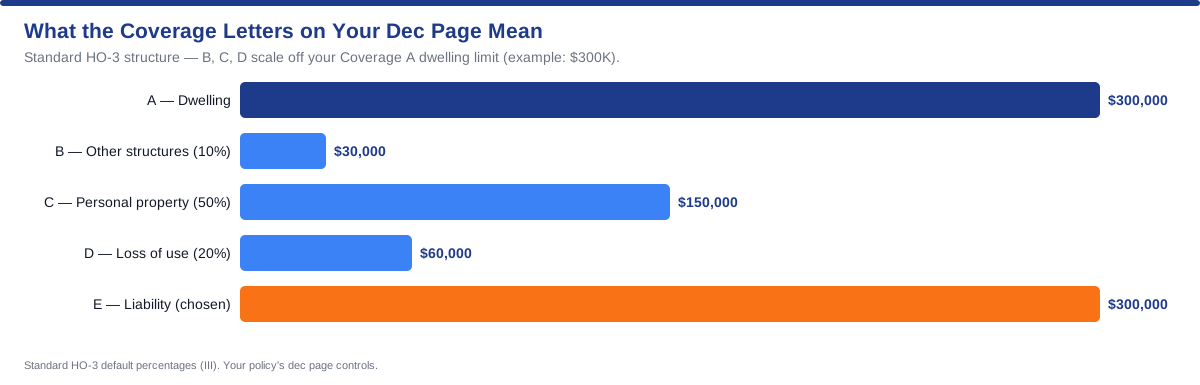
The Header: Who and What
At the top you'll find the named insured (you and any co-owner), the policy number, the policy period (start and end dates — coverage exists only inside this window), and the agent and insurer. Confirm the names are spelled correctly and the address matches the insured property. A mismatch here is a common, fixable source of claim delays.
Coverages and Limits
This is the heart of the page: a list of coverages, each with a limit — the maximum the insurer will pay for that category. On a home policy you'll see dwelling (Coverage A), other structures (B), personal property (C), loss of use (D), and liability (E). On auto, you'll see bodily injury liability, property damage liability, and your physical-damage coverages. The limit is not what you'll receive automatically; it's the ceiling. If your dwelling limit is $350,000, that's the most you can collect to rebuild, so it should track your rebuild cost, not your mortgage balance.
Deductibles
Each coverage line typically carries a deductible — the amount you pay before insurance responds. A $1,000 home deductible and a $500 auto deductible are common, but some policies use percentage deductibles (e.g., 2% of dwelling) that become large on expensive homes, and separate wind/hail or hurricane deductibles in coastal states. Know which deductible applies to which peril; a "2% hurricane deductible" on a $400,000 home means $8,000 out of pocket for that claim.
The Premium
The premium is what you pay for the term shown. Note whether it's annual or semi-annual, and whether discounts (multi-policy, claims-free, paperless) are listed. If the premium seems low, check that no coverage line is missing — a missing coverage is the silent way a quote "wins."
Endorsements and Special Conditions
The dec page lists endorsements — add-ons that modify the base policy. These might include water-backup coverage, scheduled personal property for jewelry, ordinance-or-law, or extended replacement cost. If you asked for a coverage and it's not on this list, it isn't in force. Treat the dec page as the receipt for every promise the agent described.
What the Dec Page Does NOT Show: Exclusions
The dec page rarely lists exclusions — those live deeper in the policy form. That's the trap. Flood, earthquake, and often sewer-backup are excluded from standard home policies; certain auto uses (rideshare, delivery) may be excluded from personal auto. The dec page tells you what's covered; the exclusions tell you what isn't. Pair the two by asking your agent, "What's the biggest thing NOT on this page that I might assume is covered?"
A Quick Reading Checklist
| Check | Why it matters |
|---|---|
| Names & address correct | Prevents claim delays |
| Policy dates current | No gap in coverage |
| Dwelling limit ≥ rebuild cost | Avoids underinsurance |
| Deductibles known per peril | No surprise at claim |
| Endorsements present | Confirm add-ons exist |
| Exclusions understood | Flood/quake not assumed |
Reading Your Liability Limits (the numbers that protect your assets)
On a home dec page, Coverage E (personal liability) is the limit that responds if someone is injured on your property or you're responsible for damage elsewhere - a delivery driver who slips on your stairs, a tree from your yard that falls on a neighbor's roof. Common limits are $100,000, $300,000, or $500,000. These numbers protect your savings and home equity from a lawsuit, so they deserve as much attention as the dwelling limit. If your assets exceed the liability limit, that gap is exactly what an umbrella policy fills - typically in $1 million increments above the underlying home and auto liability. The dec page should show the underlying limits the umbrella sits on; if it doesn't, ask.
How to Spot a Coverage Gap on the Dec Page
Four quick comparisons reveal most gaps:
- Dwelling limit vs. rebuild estimate - if your Coverage A is $300,000 but rebuilding your home would cost $380,000, you're underinsured by $80,000.
- Personal property as a percentage - many policies set Contents at 50 to 70% of dwelling; verify that's enough for your belongings.
- Named perils vs. open perils - a "named perils" form covers only listed causes; "open perils" (special form) covers everything except exclusions, and is broader.
- Scheduled items - jewelry, art, or electronics above sub-limits should appear as scheduled endorsements, not just in a generic personal-property line.
Catching a gap on the dec page - calmly, before a loss - is the difference between a covered claim and a devastating surprise.
A Sample Homeowners Dec Page, Line by Line
| Line | Shown | What to check |
|---|---|---|
| Coverage A - Dwelling | $350,000 | >= rebuild cost |
| Coverage C - Personal property | $175,000 | >= contents value |
| Coverage E - Liability | $300,000 | Asset protection |
| All-peril deductible | $1,000 | Affordable from savings |
| Hurricane deductible | 2% | $7,000 on this home |
This single sheet, read once a year, tells you more about your financial security than any marketing brochure.
When to Request a Corrected Dec Page
Any change to your policy should produce a new dec page: adding an endorsement, increasing a limit, dropping a peril, or correcting a name or address. Mortgagee-clause errors are especially common - if your loan servicer's name is misspelled or missing, the lender may not receive proof of insurance and could buy expensive force-placed coverage on your behalf. Request the revised dec page and confirm the change actually appears; a verbal "it's done" is not coverage. Store the latest dec page with your other important documents and revisit it at every renewal.
The Auto Declarations Page: What's Different
An auto dec page reads differently from a home one. Instead of Coverages A-E, you'll see bodily injury liability (per-person / per-accident limits like 100/300), property damage liability, medical payments or PIP, and your physical damage coverages (collision and comprehensive) with their own deductibles. The limits here protect you from liability lawsuits and repair your own car; verify the liability limits match your asset exposure and that collision/comprehensive deductibles are affordable. As with home, confirm the named drivers and vehicles are correct - an unlisted teenage driver or a wrong VIN is a classic source of a denied auto claim.
Binder, Dec Page, and Certificate of Insurance
Three documents are easily confused. A binder is temporary proof of coverage issued before the full policy is finalized. The declarations page is the summary of the in-force policy. A certificate of insurance is a third-party summary (often required by a landlord, lender, or client) confirming you hold coverage. If you're asked for proof - say, by a mortgage servicer or a commercial lease - the certificate or dec page suffices; you generally don't hand over the full policy. Knowing which document is requested saves time and avoids sharing more than necessary.
Reading the Mortgagee Clause
On a home dec page, the mortgagee (lender) clause names your loan servicer as an interested party entitled to notice of cancellation and to claim proceeds alongside you. If this clause is missing or misspelled, the lender may not be notified of a lapse and could buy force-placed insurance at your expense - or miss a claim payment it's entitled to. Verify the clause matches your current servicer, especially after a loan is sold (which happens often). A correct mortgagee clause is a small detail with large consequences, and it belongs on your annual dec-page review checklist.
How Often to Re-Read the Dec Page
The dec page isn't a read-once document. Re-read it at every renewal, after any policy change, and after any life event that affects your risk (a renovation, a new valuable purchase, a new driver). Each renewal can quietly shift limits, deductibles, or endorsements - sometimes because you asked, sometimes because the insurer revised the product. A five-minute read each year catches drift before a loss exposes it. Pair it with the exclusions conversation from your agent, and store the latest version with your other important papers. The dec page is the contract you actually live by; treat it as a living document, not a one-time form you file and forget.
Use the Dec Page as Your Agent Conversation Script
The dec page is the perfect agenda for an annual check-in with your agent: walk the coverages line by line and ask, for each, "what's the biggest thing not covered here?" That single question surfaces flood, earthquake, sewer-backup, and business-use gaps that the page won't list. A good agent welcomes the review; one who dodges it is a reason to question the policy. Treat the dec page as the contract you're judging the rest of the relationship against, not just a form to file away and forget until a loss forces you to read it.
Related Articles
Deductible vs. Premium
The trade-off that sets your cost
What Is Homeowners Insurance
Coverage, perils, and policy structure
The Insurance Claims Process
Step-by-step from filing to payout
How to Choose an Insurance Company
Compare financial strength and complaints
Explore State Guides
California Insurance
Local rates & requirements
New York Insurance
Local rates & requirements
Texas Insurance
Local rates & requirements
Frequently Asked Questions
No. The dec page is a summary — who, what, limits, deductible, and premium. The full policy includes the policy form with definitions, conditions, and exclusions. The dec page tells you what you bought; the form tells you exactly how it pays and what it excludes.
No — it should match your rebuild cost, which can be higher or lower than the mortgage. After a total loss, you need enough to reconstruct the home, not to pay off the loan. Underinsuring the dwelling is a common and expensive mistake, especially in high-cost labor markets.
Some policies, especially in coastal or wildfire-prone areas, use a percentage deductible (e.g., 1%–5% of the dwelling limit) for wind, hail, or hurricane losses. On a $400,000 home, a 2% deductible means $8,000 out of pocket for that peril. Know which perils trigger which deductible before a storm, not during one.
Then it isn't in force. Endorsements only take effect when they appear on the dec page. Contact your agent immediately to add it and request a revised dec page; don't assume a verbal agreement created coverage.
Usually not. Exclusions live in the policy form. The most important ones to confirm verbally are flood, earthquake, and sewer/water backup for home policies, and business or rideshare use for auto. Ask your agent directly what major perils are not covered.
Related Tools
Home & Renters Calculator
Estimate home insurance cost
Car Insurance Calculator
Estimate your monthly premium
Flood Insurance Calculator
Estimate NFIP & private flood cost
Data sources: NAIC, Insurance Information Institute (III). Last updated: July 2026. This article is original editorial content for educational purposes and does not constitute insurance advice; review your actual policy form for binding terms.