Most people discover umbrella insurance only after a catastrophe — a guest drowns in the backyard pool, a teenage driver causes a multi-car pileup, or a social-media post turns into a defamation suit. The standard liability limits on a home or auto policy (often $100,000 to $300,000) are designed for ordinary accidents, not catastrophic ones. When a judgment runs into the millions, the umbrella policy is what stands between you and a lien on your home, your savings, and your future wages. The surprising part is how little this protection costs.
Estimate Your Umbrella Cost
See what an extra $1M–$5M of liability protection might run based on your assets.
Open the Umbrella Calculator →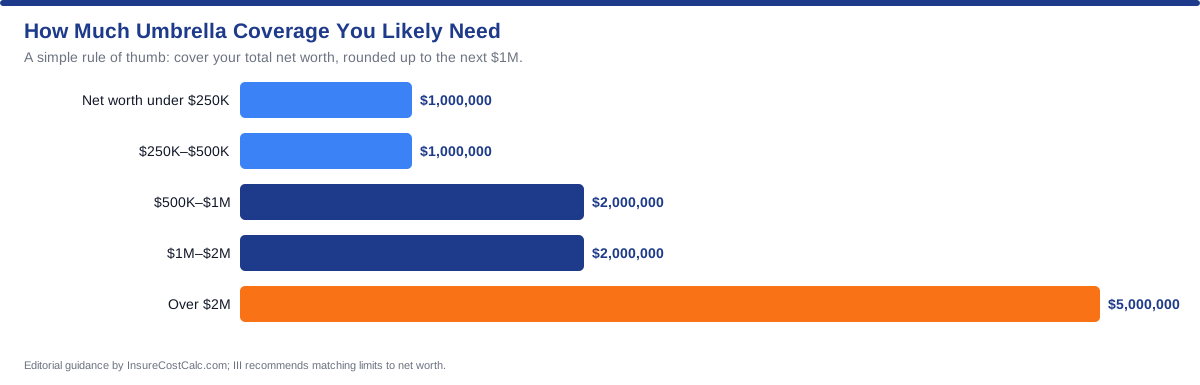
What Umbrella Insurance Actually Covers
An umbrella (or "excess liability") policy sits on top of your underlying home, auto, and sometimes boat or rental policies. It kicks in only after those policies' liability limits are exhausted. It extends three kinds of protection: higher bodily-injury and property-damage liability, personal liability (a guest injured on your property, a dog bite, a fall), and "personal injury" liability such as defamation, false arrest, or invasion of privacy — coverage that standard policies usually exclude.
Critically, umbrella can also cover liability situations your underlying policies don't touch, like a rental property you own or a claim arising abroad. It is broad, not narrow. What it does not cover is your own injuries or property damage, damage to items you own, or business liabilities (unless endorsed).
How Much It Costs
This is the part that surprises people. The first $1 million of umbrella coverage often costs $150 to $400 a year, and each additional million typically adds only $100 to $200. For the price of a nice dinner out, you can buy a million dollars of liability protection that would otherwise require your underlying limits to be maxed out at many times the cost. Households with teen drivers, pools, trampolines, or dogs flagged as risky will pay more, but it is still inexpensive relative to the exposure.
Who Should Seriously Consider It
- Your net worth approaches or exceeds your current liability limits. If you have $600,000 in assets and only $300,000 of auto liability, a single bad crash could wipe out the difference.
- You have a pool, trampoline, or dog. These raise the odds of a severe bodily-injury claim. Some insurers won't even write umbrella without certain safety features.
- You have a teenage or newly licensed driver. Young drivers cause a disproportionate share of serious accidents.
- You own rental property or serve on a board. These create liability your home policy doesn't cover.
- You are a public figure or active on social media. Personal-injury (defamation) coverage is increasingly valuable.
How to Size the Limit to Your Net Worth
A reasonable heuristic is to carry umbrella limits equal to your total net worth, rounded up to the next million. Someone with $400,000 in assets can often stay at $1M; someone with $1.3M in home equity, retirement, and savings should consider $2M; high-earners and business owners may want $3M to $5M. The chart above shows the rough mapping. Remember that a judgment can reach not just current assets but future income, so err on the side of more if you have a long career ahead.
The Underlying-Coverage Requirement
Insurers won't sell you an umbrella in a vacuum. They require you to carry minimum liability limits on the underlying policies first — commonly $250,000/$500,000 bodily injury and $100,000 property damage on auto, and $300,000 personal liability on home. The umbrella then extends above those. If your underlying limits are lower, the insurer will either reject the application or force higher underlying limits, which slightly raises those base premiums.
Common Exclusions to Know
- Your own injuries or damage to your property — that is what your health and property coverages are for.
- Business or professional liability — unless you add a specific endorsement (e.g., for a home-based business).
- Intentional or criminal acts — no policy pays for deliberate harm.
- Certain dog breeds or high-risk vehicles — may be excluded or surcharged by the underlying carrier.
A Side-by-Side Cost View
| Scenario | Typical annual umbrella premium |
|---|---|
| $1M — clean record, no pool | $150–$250 |
| $1M — teen driver + pool | $250–$400 |
| $2M — multiple homes | $250–$450 |
| $5M — high net worth | $600–$900 |
Steps to Buy an Umbrella Policy
- Total your net worth (home equity, savings, retirement, investments, future earning potential).
- Raise underlying limits on auto and home to the insurer's required minimums.
- Get quotes from your current carriers first — bundling umbrella with home/auto is usually cheapest.
- Confirm the personal-injury (defamation) coverage is included, not excluded.
- Re-evaluate after big life changes — a new home, a new driver, or a jump in income.
Real-World Claim Scenarios
Numbers are abstract until a claim lands. Imagine a guest slips at your pool and suffers a $400,000 brain injury; your home liability limit is $300,000, leaving $100,000 exposed — money the umbrella pays. Or your teenage driver causes a multi-car accident with $750,000 in injuries; auto liability caps at $300,000 and the umbrella covers the rest. In both cases, without the umbrella the injured party can pursue your home equity and future wages directly. The premium for that protection is often less than a single restaurant dinner per month, yet it is the difference between a contained insurance event and a personal financial catastrophe.
Umbrella vs. Simply Raising Underlying Limits
You might wonder why not just raise the auto or home liability limit instead of buying umbrella. The answer is cost and breadth. Pushing your auto bodily-injury from $300K to $1M can be expensive and only protects auto claims; a $1M umbrella extends across home, auto, and often rentals for less, and adds personal-injury (defamation) coverage those policies exclude. Umbrella is the more efficient way to buy catastrophic protection once your underlying limits meet the insurer's minimums — it is the cheapest million dollars of liability you can buy.
Does Umbrella Cover Business or Rental Activity?
A standard umbrella follows you as an individual, so it usually extends to a rental property you own (the underlying landlord policy is the base). It does not cover a business you operate — a home-based business needs a separate commercial policy or endorsement. If you serve on a nonprofit board, many umbrellas cover volunteer directorship liability, but some exclude it, so confirm the wording. The key is that the umbrella sits above a personal underlying policy; any activity needing its own commercial base sits outside the umbrella's reach.
How Long Does a Policy Last?
Umbrella policies are typically sold in one-year terms you renew annually, and the rate can rise if your risk profile changes — a new teen driver, a filed claim, or substantially more assets. Unlike term life, there is no "level premium" guarantee for decades. Budget for the possibility that the premium creeps up, and re-shop every few years just as you would your home and auto, because loyalty rarely lowers the price and a new carrier may quote the same limit for less.
A Net-Worth Sizing Worksheet
To size your limit precisely, total these: home equity (market value minus mortgage), retirement and brokerage accounts, savings and CDs, the cash value of any whole life you own, and a rough estimate of one to two years of future income a plaintiff could pursue. If that sum is $450,000, a $1M umbrella clears it with room to spare; at $1.4M, step up to $2M. The worksheet is not about paranoia — it is about matching the limit to the actual target a plaintiff's attorney would aim at. Re-run it whenever a big asset or income change occurs, because the right limit moves with your balance sheet.
Umbrella and Boat or RV Coverage
If you own a boat, ATV, or recreational vehicle, your umbrella can often extend over those liabilities too — but only if the underlying policy for that vehicle meets the insurer's minimum limits, and not all carriers include all toys. A jet ski liability claim that exceeds the watercraft policy's limit is exactly the kind of gap an umbrella is built to catch. Tell your agent about every registered vehicle you own; the umbrella quote may need a small adjustment, but the breadth it adds across all your liabilities is part of its value.
Related Articles
Term vs. Whole Life
Pick the right protection
How to Choose an Insurer
Financial strength & complaints
Home Endorsements
Close the gaps in your policy
Adding a Teen Driver
Why premiums spike
Explore State Guides
Florida Insurance
Local rates & requirements
Texas Insurance
Local rates & requirements
California Insurance
Local rates & requirements
Frequently Asked Questions
It extends your liability limits far above the $100K–$300K on standard policies and adds "personal injury" coverage — defamation, false arrest, invasion of privacy — that home and auto policies typically exclude. It also covers liability situations those policies don't reach, like a rental property or a claim arising while traveling abroad.
A common rule is to match your limit to your net worth, rounded up to the next million. If you have $400K in assets, $1M is usually enough; with $1.3M, consider $2M; high earners may want $3M–$5M. Because a judgment can reach future income, lean higher if you have a long career ahead.
It only pays after your underlying policies are exhausted, so the insurer's expected payout is rare and large-but-infrequent. That statistical profile makes the per-dollar cost very low — roughly $150–$400 a year for the first $1M, with each added million costing only $100–$200 more.
Yes. Insurers require minimum underlying liability limits (commonly $250K/$500K BI and $100K PD on auto, $300K on home) before they will issue an umbrella. If yours are lower, the insurer will require you to raise them, which slightly increases those base premiums.
No. Umbrella is liability-only — it pays when you are legally responsible for harm to others or their property. Your own medical bills and damage to your own belongings are handled by your health, auto, and property policies, not the umbrella.
Re-evaluate after any major asset or liability increase: buying a home, a jump in income or savings, adding a pool or teen driver, acquiring a rental, or joining a corporate board. A good habit is to review it at every home and auto renewal.
Related Tools
Umbrella Insurance Calculator
Estimate extra liability cost
Home & Renters Calculator
Estimate home insurance cost
Car Insurance Calculator
Estimate your monthly premium
Data sources: Insurance Information Institute (III), NAIC. Last updated: July 2026. This article is original editorial content for educational purposes and does not constitute insurance advice; consult a licensed agent for decisions specific to your situation.