Few numbers shock parents like the one that appears after adding a 16-year-old to the family auto policy. Insurers price teenage drivers as the highest-risk group on the road, and the math reflects it: a married couple paying $1,600 a year can see that jump past $4,000 once a new driver is listed. The good news is that the increase is not fixed — it responds sharply to the discounts you apply and the car your teen drives. This guide explains the pricing and the levers that control it.
See the Impact on Your Premium
Model your household before you quote — and after each discount.
Open the Car Insurance Calculator →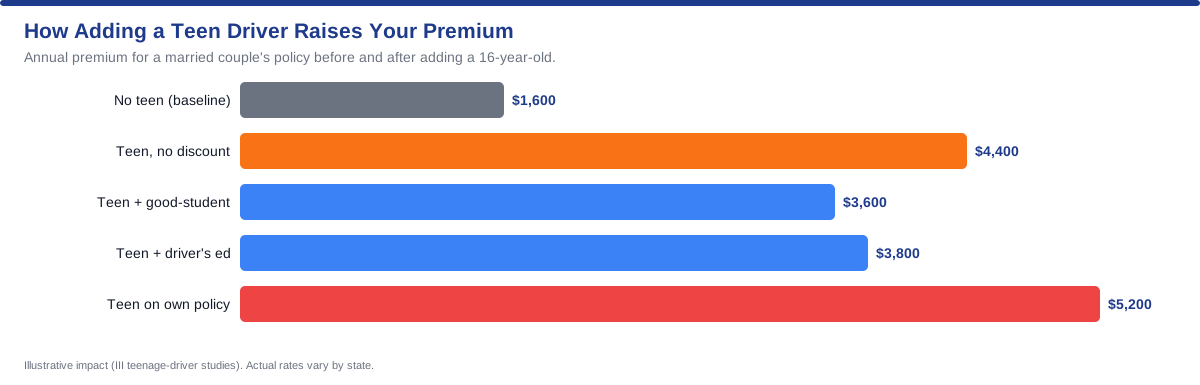
Why Teen Drivers Cost So Much
The rate reflects risk, not punishment. Drivers aged 16–19 are involved in crashes at roughly three to four times the rate of older adults, and the severity of those crashes tends to be higher. Insurers price expected losses, so a newly licensed teen carries a heavy surcharge. Males typically cost more than females at younger ages (the gap narrows by the mid-20s), and a teen on their own policy — rather than listed on a parent's — is usually the most expensive option of all.
Lever 1: The Good-Student Discount
Most major insurers cut 10–25% for full-time students who maintain a B average (roughly 3.0 GPA) or better. The logic: good students are statistically more responsible behind the wheel. You will need to submit a report card or transcript once a year. For a household facing a $4,400 teen surcharge, a 15% good-student discount alone can save $600+ annually.
Lever 2: Driver's Education & Safe-Driving Courses
Completing an approved driver's-ed program or a defensive-driving course often triggers a discount of 5–15%. Beyond the discount, proper training genuinely reduces crash risk — which matters because a single at-fault accident can erase years of savings. Some insurers also offer a "student away at school" discount if the teen attends college more than a set distance (e.g., 100 miles) from home and doesn't keep a car there.
Lever 3: Telematics / Usage-Based Programs
Programs like Progressive Snapshot, State Farm Drive Safe & Save, or Allstate Drivewise monitor actual driving (braking, speed, time of day, mileage) via an app or plug-in. Safe behavior can yield 10–30% off. For a teen, this is doubly valuable: the discount rewards good habits and the monitoring itself encourages them. Set expectations clearly — harsh braking or late-night driving can reduce the discount rather than increase it.
Lever 4: The Car Your Teen Drives
The single biggest controllable factor after the driver is the vehicle. Insurers charge more for sports cars, high-horsepower models, and vehicles with high theft rates. A safe, modest, older sedan with good crash-test ratings and standard safety features (automatic braking, lane-keeping) is dramatically cheaper to insure than a flashy coupe. Putting the teen on the family's oldest, safest car — and keeping the newer car for the parents — often lowers the total bill versus the reverse.
Lever 5: Raise Deductibles — Carefully
Because the teen raises your expected claims, a higher collision/comprehensive deductible on the teen's vehicle trims premium. But weigh this against the reality that new drivers are more likely to file a claim; a $1,000 deductible you can't easily cover defeats the purpose. Apply it to the teen's car, not the family's primary vehicle, and keep an emergency fund to match.
List Them or Insure Separately?
In almost every case, adding the teen to the parents' policy is cheaper than a standalone policy, because the household keeps multi-car and bundling discounts and the teen benefits from the parents' longer history. A separate policy makes sense only in narrow situations — e.g., an emancipated teen with their own vehicle and address, or when the parents' record is so poor that a separate policy isolates the risk. Get both quotes; the difference is often large.
What the Numbers Look Like
| Scenario | Annual premium |
|---|---|
| Parents only (baseline) | $1,600 |
| + Teen, no discount | $4,400 |
| + Teen, good-student | $3,600 |
| + Teen, driver's ed | $3,800 |
| + Teen, own policy | $5,200 |
A Pre-Teen-Driver Checklist
- Get the good-student paperwork ready before you call the insurer.
- Enroll in driver's ed — both for safety and the discount.
- Sign up for telematics the day the teen is licensed.
- Assign the safest, oldest family car to the teen.
- Shop at renewal — teenage-driver rates vary enormously by carrier.
A Real Family's Numbers
Take a family in Texas paying $1,600 for two experienced drivers on a paid-off sedan and an SUV. Adding a 16-year-old son with his own used sedan and no discounts pushes the bill to about $4,400. Apply a good-student discount (he carries a 3.4 GPA) and the telematics program, and it drops to roughly $3,300. Put him on the older, safer SUV instead of the sportier sedan, and it falls further. The point: the headline "doubles your premium" is a starting point, not a sentence — the final number is highly controllable through the levers above.
What If the Teen Has Their Own Car?
Whether the teen drives the family car or a car titled to them, they still must be listed as a driver on your policy (or their own). Insuring a car solely in a teen's name is usually more expensive and can create coverage gaps if the parents' policy doesn't extend. The cheapest arrangement is typically the teen listed on the parents' policy, assigned to the safest family vehicle, with every available discount applied. Only consider a separate policy if the parents' record is poor enough that it inflates the household rate.
Setting Expectations With Your Teen
The discounts only pay off if the behavior matches. Talk through the telematics program before it starts — harsh braking, late-night driving, and rapid acceleration can reduce the discount. Many families use the monitoring as a coaching tool: review the app's feedback together monthly. A teen who understands that safe driving literally lowers the family bill is more likely to drive carefully, which also reduces the odds of an at-fault accident that would erase years of savings.
The Multi-Teen Household
Families with two or three teens face a different math. Stacking multiple young drivers on one policy multiplies the surcharge, but insurers often cap how much each additional teen adds, and multi-teen households may qualify for "good student" on each. If the teens drive different cars, assign the safest, oldest vehicle to the highest-risk driver. Once the oldest teen ages into the lower surcharge tier (18–19, then 21), the household's total premium can drop sharply — which is a good moment to re-shop, because the carrier that was cheapest with one teen may not be with a mix of ages.
The Age and Gender Curve
Teen rates are not static. A 16-year-old is the most expensive; by 18–19 the surcharge drops noticeably as the driver is no longer "newly licensed"; at 21 it falls again; and through the mid-20s it converges toward adult rates as the gender gap closes. Males typically cost more than females at younger ages, a difference that narrows by the mid-20s. Knowing this curve helps you plan: the painful premium is front-loaded into the first two years, after which re-shopping usually finds a meaningfully lower rate even with the same carrier.
The Bottom Line
Adding a teen driver is expensive but predictable, and the number is far more controllable than the headline "doubles your premium" suggests. Start with three quotes, list the teen on your policy, assign the safest family car, stack every discount, and enroll in telematics on day one. Re-shop at each renewal as the surcharge naturally falls with age. With those levers, most families land well below the worst-case estimate — and keep a newly licensed driver properly protected from the first mile.
Related Articles
Car Coverages Explained
What each line pays for
Lower Your Car Insurance
12 proven savings tactics
Umbrella Insurance
Extra liability for new drivers
Deductible vs. Premium
The break-even math
Explore State Guides
Texas Insurance
Local rates & requirements
California Insurance
Local rates & requirements
New York Insurance
Local rates & requirements
Frequently Asked Questions
In almost all cases, adding them to your policy is cheaper — you keep multi-car and bundling discounts and the teen benefits from your longer history. A standalone policy is usually only worth it when the parents' record is poor or the teen is financially independent with their own address. Always get both quotes.
Typically 10–25% off the teen's portion of the premium. For a household facing a $4,400 teen-inclusive bill, a 15% good-student discount can save $600 or more a year. You generally need to show a B average (3.0 GPA) or better and re-verify annually.
Yes — often as much as the driver discounts. Sports cars, high-horsepower models, and high-theft vehicles cost far more to insure. A safe, modest, older sedan with strong safety ratings is dramatically cheaper. Put the teen in the family's oldest, safest car rather than the newest one.
Often 10–30% for safe driving, and it encourages better habits through monitoring. The caveat: poor behavior (harsh braking, frequent late-night driving) can reduce the discount. Set expectations with your teen and treat it as a coaching tool, not just a coupon.
Yes. The surcharge falls steeply at 18–19 (when they are no longer a "new" driver), again at 21, and continues to decline into the mid-20s as experience accumulates and (for males) the gender gap closes. Keeping them on the policy through this period is usually cheaper than moving them off and back on.
Many insurers offer a "student away at school" discount if the college is beyond a set distance (commonly 100 miles) and the teen doesn't keep a car there. You keep them listed as a driver (so they're covered when they visit home) but pay less. Confirm the exact distance rule with your carrier.
Related Tools
Car Insurance Calculator
Estimate your monthly premium
Umbrella Insurance Calculator
Estimate extra liability cost
Home & Renters Calculator
Estimate home insurance cost
Data sources: Insurance Information Institute (III), NAIC. Last updated: July 2026. This article is original editorial content for educational purposes and does not constitute insurance advice; consult a licensed agent for decisions specific to your situation.