Ask for "full coverage" and you will get a stack of coverages with a single price — but each line pays for something completely different, and each can be tuned up or down. When you are trying to save money, the worst move is to drop the wrong one. The smart move is to understand what every coverage actually does, which ones your state or lender forces you to carry, and which ones you can safely trim. This guide decodes the standard auto policy line by line.
Estimate Your Auto Premium
See how coverage choices change your monthly cost before you quote.
Open the Car Insurance Calculator →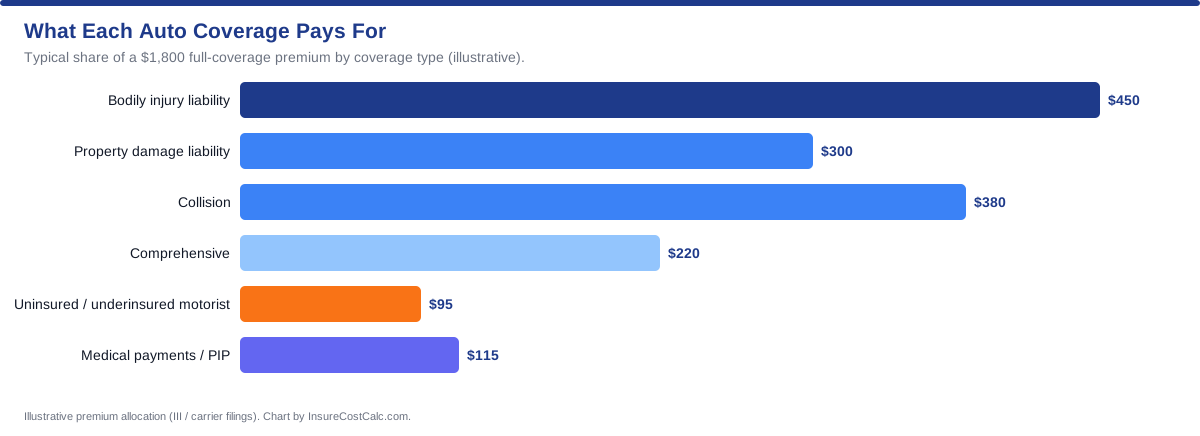
1. Bodily Injury Liability (BI)
This is the coverage that pays for injuries you cause to other people — medical bills, lost wages, and legal settlements if you are sued. It is measured as two limits, e.g., "$50,000 per person / $100,000 per accident." Almost every state requires it, and it is the line you most want high, because a serious injury can blow past a low limit and leave your assets exposed. Bumping from state-minimum limits to $100K/$300K is usually inexpensive and one of the best values in insurance.
2. Property Damage Liability (PD)
PD pays to repair or replace the other driver's car and any property you hit — a fence, a mailbox, a building. Limits are a single number, e.g., $50,000. With new vehicles routinely costing $40,000–$60,000, a $25,000 limit is risky; $50,000 or $100,000 is the safer floor. PD is also required in nearly every state.
3. Collision
Collision covers damage to your own car when you hit another vehicle or object, regardless of fault. It is optional unless your lender requires it (and they will, on a lease or loan). The key levers are your deductible ($250, $500, $1,000, or more) and the value of your car — once your car is worth less than a few thousand dollars, collision often costs more than it pays.
4. Comprehensive (a.k.a. "Other Than Collision")
Comprehensive pays for damage to your car from almost everything except a collision: theft, vandalism, fire, hail, flooding, falling trees, and hitting an animal. Like collision, it is lender-required and deductible-driven. It is usually cheap relative to the protection — a $100 deductible comprehensive policy is one of the few auto lines worth keeping even on an older car in a storm-prone or high-theft area.
5. Medical Payments (MedPay) & Personal Injury Protection (PIP)
MedPay and PIP pay medical bills for you and your passengers regardless of fault. PIP, required in "no-fault" states, is broader — it can cover lost wages and essential services too. If you have strong health insurance, MedPay may be redundant; if you have a high-deductible health plan or no health coverage, it is valuable. States vary widely on whether either is required.
6. Uninsured / Underinsured Motorist (UM/UIM)
Roughly one in eight drivers is uninsured, and many more carry only state-minimum limits that won't cover a serious injury. UM pays your bills if a hit-and-run or uninsured driver hits you; UIM kicks in when the at-fault driver's limits are too low. This is one of the most underrated coverages — it protects you from someone else's irresponsibility. In many states it is mandatory or can only be rejected in writing.
Optional Add-Ons Worth Knowing
- Rental reimbursement — pays for a rental while your car is in the shop after a covered claim.
- Roadside assistance — towing, jump-starts, lockouts; often cheaper than an auto-club membership.
- Gap insurance — covers the loan-vs-value shortfall if your car is totaled (see our gap insurance guide).
- Accident forgiveness — your first at-fault accident won't raise your rate (usually after a clean period).
- New-car replacement — pays for a brand-new equivalent rather than ACV if your new car is totaled.
How the Coverages Map to Your Premium
The chart above shows how a typical $1,800 full-coverage premium divides among the coverage types. Liability (BI + PD) is the largest slice — and the most important to keep high. Collision and comprehensive scale with your car's value, so they are the natural place to raise deductibles on an older vehicle. PIP/MedPay and UM/UIM are comparatively small but protect you directly, so don't slash them to save a few dollars.
A Coverage Checklist
| Coverage | Usually required? | Our suggested floor |
|---|---|---|
| Bodily injury liability | Yes (state) | 100/300 |
| Property damage liability | Yes (state) | 50,000+ |
| Collision / comprehensive | If financed | $500 deductible |
| UM / UIM | Often yes | Match BI |
| MedPay / PIP | Varies | $5,000+ |
Where People Overspend — and Under-spend
The classic mistake is carrying $1,000 deductibles on a 12-year-old car (paying for collision you'll rarely use net of the deductible) while keeping state-minimum liability (leaving your savings exposed to a lawsuit). Flip it: keep liability generous, and consider dropping collision/comprehensive once your car's value falls below roughly five times the annual premium. The reverse — skimping on UM/UIM to save $20 a year — is the other common error.
How a Claim Is Paid Across Coverages
A real example makes the structure concrete. You hit a guardrail (your fault), damaging your car and a parked car. Collision pays for your car (minus your deductible); property damage liability pays for the parked car; if you are injured, MedPay or PIP pays your initial bills; if the other car's driver sues you for injuries, bodily injury liability responds. No single coverage does everything — they stack to cover the whole event. Understanding this prevents the shock of discovering, say, that collision won't pay for the other driver's car, or that your injury bills fall to PIP rather than liability.
The State-Minimum Trap
Buying only your state's minimum liability is legal but dangerous. Minimums like 25/50/25 ($25K per person, $50K per accident BI, $25K PD) were set decades ago and have not kept pace with medical or vehicle costs. A single serious injury can blow past $50K, exposing your savings and home. The jump from state minimum to 100/300/100 is usually modest in premium but transforms your protection. Treat the state minimum as the floor you are allowed to buy, not the amount you should carry.
Matching Coverage to Your Life Stage
A new driver with few assets can carry higher liability relative to their means because they have little to protect but a long future of earnings to defend; a mid-career homeowner should maximize liability and add umbrella; a retiree who has paid off the house may drop collision on an old car but keep robust liability. The constant is that liability protects your accumulated wealth and future income, while collision and comprehensive protect the car itself — and the right balance shifts as your net worth and vehicle value change.
How Deductibles Interact With Coverages
Your deductible applies per coverage, not per accident, which surprises people. A single crash that damages your car and injures you can trigger the collision deductible (on your car) and the MedPay/PIP cost-sharing (on your medical bills) separately — but not the liability deductible, because liability has no deductible (you don't pay to cover others). Raising the collision and comprehensive deductibles lowers your premium but means you absorb more of your own damage; lowering them costs more but reduces your out-of-pocket after a crash. The right deductible is the largest amount you could comfortably pay from savings without distress.
Bundling and Multi-Car Discounts
The coverages above are priced per vehicle and per driver, but the total bill is shaped by discounts that interact with them. Bundling auto with home, insuring multiple cars on one policy, and a clean driving record all lower the overall premium without changing which coverages you carry. The strategy is to set the coverage structure first — adequate liability, sensible deductibles, UM/UIM — then apply every eligible discount on top. Discounts never substitute for the right coverages; they simply make the right coverages cheaper, which is why you should optimize the structure before hunting for the discount.
Related Articles
Lower Your Car Insurance
12 proven savings tactics
Adding a Teen Driver
Why premiums spike
Gap Insurance Explained
Loan vs. value after a total loss
Deductible vs. Premium
The break-even math
Explore State Guides
California Insurance
Local rates & requirements
New York Insurance
Local rates & requirements
Texas Insurance
Local rates & requirements
Frequently Asked Questions
It is not a single coverage but a bundle: liability (BI + PD) plus collision and comprehensive, often with MedPay/PIP and UM/UIM. There is no official definition, so two "full coverage" quotes can include very different limits and add-ons. Always read the dec page, not the label.
Bodily injury and property damage liability (they protect your assets and are legally required) and uninsured/underinsured motorist (it protects you from others). The safe place to cut is collision/comprehensive on an old car, or a higher deductible — not these liability lines.
Often not. A good rule: drop them once your car's market value is less than roughly five times the annual premium you pay for them (after the deductible). If the car is worth $3,000 and you pay $500/year with a $500 deductible, the most you could ever net is $2,500 — often not worth it.
MedPay pays medical bills for you and passengers after an accident, regardless of fault. PIP (required in no-fault states) is broader: it can also cover lost wages and essential household services. If you have strong health insurance, MedPay may be redundant; PIP is more valuable because of the wage-loss piece.
About one in eight U.S. drivers is uninsured, and many carry only minimal limits. If an uninsured or underinsured driver injures you, UM/UIM pays your medical bills and lost income up to your limit. It protects you from someone else's lack of coverage — which liability insurance on your own policy does not do.
Each state sets its own mandatory limits for BI, PD, and sometimes PIP or UM. Our state insurance guides summarize minimum requirements and typical premiums by state, so you can see whether you are above or below the local floor.
Related Tools
Car Insurance Calculator
Estimate your monthly premium
Umbrella Insurance Calculator
Estimate extra liability cost
Home & Renters Calculator
Estimate home insurance cost
Data sources: NAIC, Insurance Information Institute (III). Last updated: July 2026. This article is original editorial content for educational purposes and does not constitute insurance advice; consult a licensed agent for decisions specific to your situation.