The single biggest misunderstanding in home insurance is that a "standard policy" is a complete policy. It is not. The HO-3 form — the most common — covers your dwelling on a wide "open perils" basis but your belongings only on a "named perils" basis, and it quietly excludes or caps a long list of expensive scenarios: sewer backups, the cost of rebuilding to new codes, the full value of your engagement ring, and full replacement when construction costs spike. Endorsements (also called riders) are the add-ons that fix these gaps. Most cost less per year than a single dinner out.
Estimate Your Home Premium
See your baseline cost before adding the endorsements you need.
Open the Home & Renters Calculator →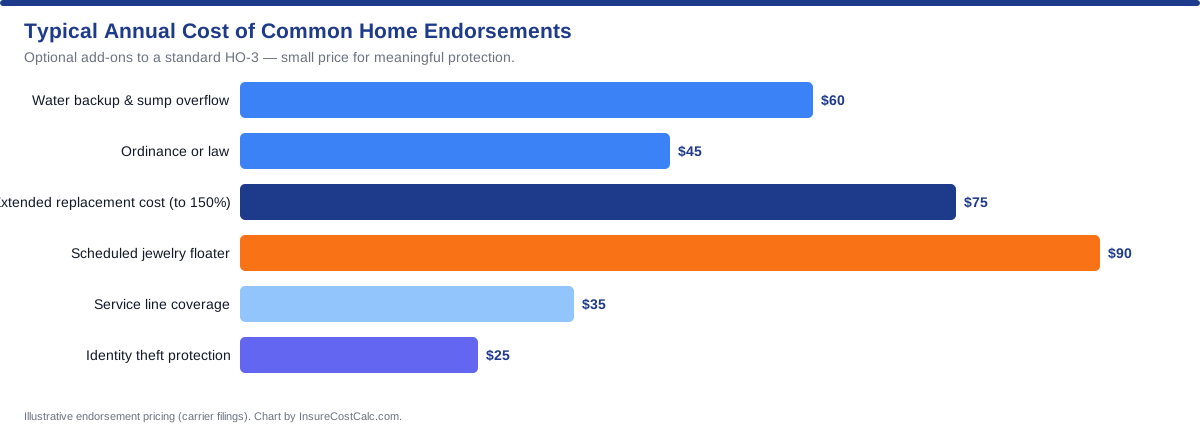
1. Extended or Guaranteed Replacement Cost
A standard policy pays to rebuild up to your Coverage A limit. But after a regional disaster, labor and lumber costs can jump 30–50%, leaving you tens of thousands short. "Extended replacement cost" adds 25–50% above your limit (e.g., 150% of Coverage A); "guaranteed" replacement cost pays whatever it takes. This is one of the highest-value endorsements for any homeowner, often costing $50–$75 a year.
2. Water Backup & Sump Overflow
Standard policies exclude damage from sewer or drain backups — one of the most common and disgusting home losses, often $10,000–$30,000 to remediate. A water-backup endorsement adds $5,000–$25,000 of coverage for $40–$80 a year. If you have a basement, a finished lower level, or an older sewer line, this is close to mandatory.
3. Ordinance or Law Coverage
If a covered loss triggers a building-code upgrade (you must now add sprinklers, raise the foundation, or rebuild to current electrical code), the base policy pays only to restore what was there. Ordinance or law coverage pays the extra cost of compliance — frequently tens of thousands on an older home. Many policies include a small amount by default; boosting it is cheap insurance against code-driven overruns.
4. Scheduled Personal Property (Floaters)
Standard belongings coverage caps high-value items — jewelry often at $1,500, electronics and art at modest sub-limits — and may pay only actual cash value. A scheduled floater "schedules" each item (engagement ring, watch, guitar, coin collection) for an agreed value, usually with no deductible and broader "all-risk" protection including accidental loss. A $10,000 ring might cost $90–$150/year to schedule. If you own anything irreplaceable, this is the endorsement that matters most.
5. Service Line Coverage
Your policy covers the house, not the buried utility lines — water, sewer, gas, power — between the street and your foundation. When a line fails, you can be on the hook for excavation and replacement, easily $5,000–$15,000. Service line coverage typically adds this for $25–$40 a year. Older homes with original clay or cast-iron lines are the prime candidates.
6. Identity Theft Protection
Some insurers bundle identity-theft expense coverage — reimbursement for legal fees, notary costs, and lost wages while you restore your identity. It is a modest add-on ($15–$30) that pairs with the credit monitoring you may already have. Less critical than the property endorsements, but inexpensive.
7. Flood and Earthquake (Separate Policies)
Worth calling out because they are not endorsements but separate policies you must buy separately — and most people wrongly assume they are included. Standard home insurance never covers flood (including storm surge and groundwater) or earthquake. If you are in a FEMA flood zone or a seismic area, see our flood insurance guide and talk to your agent about a quake policy. A surprising number of "flood" claims happen outside high-risk zones after heavy rain.
What Endorsements Typically Cost
The chart above shows typical annual prices. None are large, but together they close the gaps that turn a $40,000 loss into a $40,000 out-of-pocket bill. The right set depends on your home's age, location, and what you own.
A Prioritized Add-On List
| Endorsement | Who needs it | Typical annual cost |
|---|---|---|
| Extended replacement cost | Everyone | $50–$75 |
| Water backup | Any with basement/sewer | $40–$80 |
| Scheduled jewelry floater | Own >$1,500 valuables | $90+ |
| Ordinance or law | Older homes | $30–$60 |
| Service line | Older utilities | $25–$40 |
How to Decide What to Add
- Walk your home mentally. Basement? Old sewer line? Valuables? Coastal or seismic address? Each points to a specific endorsement.
- Read your dec page sub-limits. The standard $1,500 jewelry cap surprises people only after a loss.
- Ask for "all available endorsements" and price each; drop the ones that clearly don't fit, keep the rest.
- Revisit at renewal — a renovation, a new purchase, or a move changes your needs.
The Right Endorsements by Home Type
Not every home needs every add-on. A coastal or flood-prone home should prioritize flood (separate) and water-backup; an older home (pre-1980) benefits most from ordinance-or-law and extended replacement cost, because rebuilding to current code is expensive; a condo owner needs walls-in coverage and may skip some dwelling endorsements their HOA master policy covers; a high-value home with art or jewelry should schedule those items. Match the endorsement to the actual risk your home presents rather than buying a generic bundle.
How Endorsements Affect Your Premium
Adding the five common endorsements might raise your premium by $250–$400 a year on a typical home — a fraction of what one uncovered loss costs. Insurers usually offer them à la carte, so you can add the two or three that fit and skip the rest. Ask for the price of each individually; bundling them into a "premium package" can be convenient but sometimes includes coverages you don't need. The goal is deliberate coverage, not a bigger bill.
Reading the Endorsement Language
Like the base policy, endorsements have their own terms. Check whether a scheduled floater is "agreed value" (pays the scheduled amount) or "actual cash value" (depreciated); whether water-backup has a sub-limit that's too low for your finished basement; and whether extended replacement cost is 125%, 150%, or 200% (more is better after a regional disaster). The cheapest endorsement that under-covers your specific risk is no bargain. A five-minute read of each endorsement's limit and basis prevents a nasty surprise at claim time.
Endorsements and Claims: Why They Matter Most Then
Endorsements are invisible until you file a claim — and that is exactly when they pay off. A homeowner without water-backup coverage who suffers a sewer backup faces a $15,000 remediation bill the base policy expressly excludes; the same homeowner with the $60 endorsement pays nothing beyond the endorsement's small sub-limit. The lesson is not to buy every endorsement, but to buy the one that matches your specific, plausible loss. Read your dec page's exclusions once a year and ask your agent which endorsement would convert each major exclusion into covered protection for your home.
Bundle or Buy À La Carte?
Some insurers sell a "premium package" that bundles several endorsements at a discount, which can be convenient and occasionally cheaper than buying each separately. The downside is that packages may include coverages you don't need (raising cost) while omitting one you do. The disciplined approach is to price each endorsement individually, keep the two or three that match your home's real risks, and skip the rest. A packaged deal is only a bargain if every item in it applies to you — otherwise à la carte is both cheaper and more precise.
Reviewing Endorsements at Renewal
Endorsement needs change as your home changes. A finished basement suddenly makes water-backup essential; a new engagement ring means scheduling jewelry; a roof replacement may let you drop ordinance-or-law if the home is now modern. Each renewal, skim the dec page and ask whether any life change created a gap or made an existing endorsement redundant. Insurers rarely remove coverage you no longer need, so the review protects you from both under- and over-insuring. Fifteen minutes a year keeps the policy aligned with the house it actually protects.
Related Articles
What Is Homeowners Insurance?
Coverages, exclusions, endorsements
Read Your Dec Page
Find the sub-limits that matter
NFIP Flood Insurance
What flood policies cover
Deductible vs. Premium
The break-even math
Explore State Guides
Florida Insurance
Local rates & requirements
California Insurance
Local rates & requirements
Louisiana Insurance
Local rates & requirements
Frequently Asked Questions
In home insurance they mean the same thing: a written amendment that adds, removes, or changes coverage on your policy. "Endorsement" is the more common term in property insurance; "rider" is borrowed from life and health. Both attach to and modify the base policy form.
No — flood is excluded from standard home policies and must be bought as a separate NFIP or private flood policy. The same is true for earthquake in most states. Don't assume your agent added them; ask specifically, because a heavy-rain "flood" can happen well outside mapped high-risk zones.
Extended replacement cost is the highest-value for almost everyone — it prevents being underbuilt after a disaster when material costs spike. For homes with basements or older sewer lines, water-backup coverage is a close second. For anyone owning jewelry or art above the standard sub-limits, a scheduled floater is essential.
Often yes. A scheduled personal-property floater typically covers the agreed value with no deductible and on an "all-risk" basis (including accidental loss, which the base policy excludes). That is why it costs more than relying on the blanket belongings limit — but for a $10,000 ring, the math is compelling.
Individually they are small: extended replacement cost ~$50–$75, water backup ~$40–$80, ordinance or law ~$30–$60, service line ~$25–$40, a jewelry floater scales with value (~1% of appraised value per year). Bundled, a well-protected home might add $250–$400/year to the premium — far less than a single uncovered loss.
No. Endorsements are paid-for coverage; filing a claim under one does not penalize you differently than any other claim, though frequent claims of any kind can affect future rates. The bigger risk is the opposite — not having the endorsement means the claim is simply denied.
Related Tools
Home & Renters Calculator
Estimate home insurance cost
Flood Insurance Calculator
Estimate NFIP premiums
Umbrella Insurance Calculator
Estimate extra liability cost
Data sources: Insurance Information Institute (III), NAIC. Last updated: July 2026. This article is original editorial content for educational purposes and does not constitute insurance advice; consult a licensed agent for decisions specific to your situation.