Flood is the great blind spot of American insurance. A standard homeowners or renters policy explicitly excludes flood, so the damage from a storm surge, overflowing river, or even water seeping in from saturated ground is unpaid unless you hold a separate flood policy. The backbone of U.S. flood coverage is the National Flood Insurance Program (NFIP), run by FEMA. Knowing exactly what it covers prevents the most expensive surprise in personal insurance.
Estimate Your Flood Insurance Cost
See what NFIP or private flood coverage might run for your property.
Open the Flood Insurance Calculator →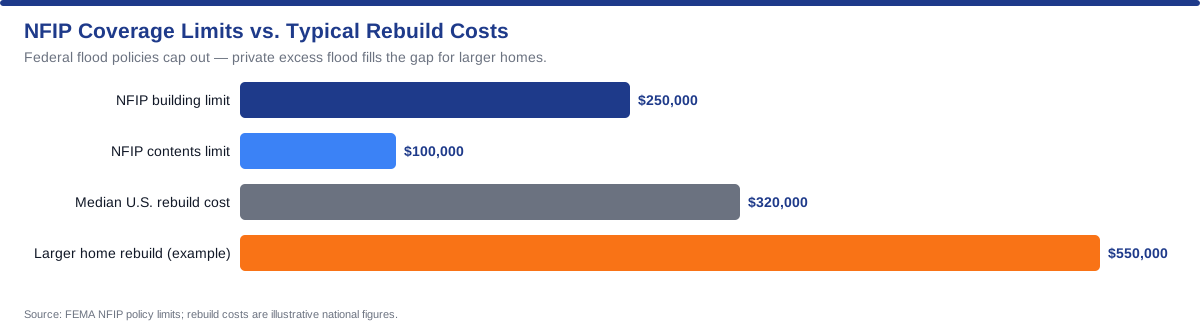
Two Parts of an NFIP Policy
An NFIP policy is actually two coverages you can buy separately:
- Building property — the structure: walls, foundation, electrical and plumbing, HVAC, cabinets, and built-in appliances, up to a statutory limit.
- Personal contents — your belongings: furniture, clothing, electronics, and portable appliances, up to its own limit. Renters typically buy contents-only.
Both are subject to deductibles and to separate limits, so a homeowner should carry both to be made whole after a loss.
The Coverage Limits
| Coverage | NFIP maximum |
|---|---|
| Building property | $250,000 (residential) |
| Personal contents | $100,000 (residential) |
| Building (commercial) | $500,000 |
| Contents (commercial) | $500,000 |
For high-value homes, the NFIP limit of $250,000 rarely rebuilds a destroyed house — which is where private flood insurance or NFIP's excess layers come in. Don't assume the NFIP cap covers your rebuild cost.
What NFIP Does NOT Cover
- Damage from earth movement (even if flood-triggered) — that's a separate earthquake/exclusion.
- Basement improvements and contents — finished basements, carpet, and belongings stored below grade are largely excluded or sharply limited.
- Temporary living expenses — NFIP does not pay loss-of-use, unlike a home policy's Coverage D.
- Outdoor property — decks, fences, pools, and landscaping are generally outside coverage.
- Financial losses — business interruption from being unable to use the property.
NFIP vs. Private Flood Insurance
Private flood insurers have expanded in recent years and often offer higher limits, lower deductibles, and sometimes broader definitions of "flood." Private rates can be cheaper for lower-risk properties and more expensive for high-risk ones. The trade-offs: private carriers sit outside the NFIP's standardized terms and may reprice or non-renew after a loss, while NFIP offers stability and is required for many federally backed mortgages in high-risk zones. Many households compare both.
Who Actually Needs It
If you're in a high-risk Special Flood Hazard Area with a federally backed mortgage, flood insurance is mandatory. But roughly one in four NFIP claims comes from outside the high-risk zone — heavy rain, failed drainage, and new development change risk fast. Anyone whose home, belongings, or business would be financially devastated by a flood should consider a policy regardless of zone, especially since there's typically a 30-day waiting period before coverage starts.
How NFIP Premiums Are Calculated (Risk Rating 2.0)
In October 2021 FEMA moved NFIP pricing to Risk Rating 2.0, a fundamentally different model. Instead of relying mainly on broad flood zones and a property's elevation relative to the zone, it now prices each policy using specifics: the property's distance to water, the type and frequency of flooding, the cost to rebuild, and the elevation of the structure's lowest floor. The goal was to make premiums better reflect true risk. The practical effect: some lower-risk properties saw rates drop, while historically underpriced higher-risk properties began rising toward actuarial levels (subject to annual rate-increase caps). Your premium is now far more about your property than your ZIP code's zone letter.
The 30-Day Waiting Period and Its Exceptions
An NFIP policy generally takes effect 30 days after purchase - a deliberate guard against buying coverage only when a storm is already forecast. There are limited exceptions: the wait is waived if the policy is required to close a loan on the property, if it follows a map revision that newly places the building in a high-risk zone (typically a 13-month window), or in certain other specified cases. The lesson is blunt: buy flood insurance before you need it, ideally when you buy or refinance the home, not the week a hurricane forms. Private flood policies may have shorter waiting periods, another point of comparison.
Documenting a Flood Loss for an NFIP Claim
If flooding hits, the claim process rewards preparation. Before cleanup, photograph everything - standing water, damaged belongings, and structural harm - from multiple angles. NFIP adjusters will want proof of ownership and value for damaged contents: receipts, photos of the items in place, or bank/credit-card statements. Keep a written inventory of what was lost and its replacement cost. For building damage, retain contractors' estimates. Because NFIP limits on basements and contents are restrictive, documenting the full extent of damage (including items stored below grade) maximizes what you recover. Report the loss to your insurer promptly and keep a log of every communication.
Community Rating System (CRS) Discounts
The NFIP's Community Rating System rewards communities that go beyond minimum floodplain management - actions like preserving open space, improving drainage, regulating development, and public flood education. Participating communities earn a discount of 5% to 45% on NFIP premiums for their residents, scaled by their CRS class. If you live in a CRS community, that discount is automatic on your NFIP policy. It's worth asking your agent or city floodplain administrator what class your community holds - a 25% or 35% reduction is a meaningful, often overlooked saving on an already costly coverage.
Elevation Certificates and Mitigation
An Elevation Certificate documents how high your structure's lowest floor sits above the base flood elevation. If your home was built to a higher standard than the zone requires - or you've elevated it - that certificate can substantially lower your NFIP premium by proving lower risk. Beyond paperwork, physical mitigation pays: elevating utilities, installing flood vents, and using flood-resistant materials in the lowest level reduce both premiums and actual damage. For a home you intend to keep for years in a flood-prone area, the upfront cost of mitigation is frequently recovered through lower premiums and avoided losses.
Flood Insurance for Renters and Condo Owners
Flood coverage isn't only for single-family homeowners. Renters can buy NFIP contents-only coverage (up to $100,000) to protect belongings from flood - the landlord's building policy won't cover a tenant's goods. Condo owners buy NFIP coverage for the unit's interior and contents (the association's master policy typically covers common areas and the building shell, not your drywall, flooring, and possessions). In all three cases the 30-day waiting period applies, and the same exclusions (basements, outdoor property, loss of use) hold. If you rent or own a condo in or near a flood zone - or even outside it, given one in four claims are elsewhere - a contents or unit flood policy is worth a quote.
Private Flood vs. NFIP: A Side-by-Side
| Dimension | NFIP | Private |
|---|---|---|
| Max building limit | $250,000 | Often $1M+ |
| Waiting period | 30 days | Sometimes shorter |
| Loss-of-use | Not covered | Sometimes covered |
| Stability | Standardized, stable | May reprice after loss |
Private can beat NFIP for lower-risk homes needing higher limits; NFIP wins for stability and mortgage acceptance in high-risk zones.
The First 24 Hours After a Flood
What you do immediately shapes your claim. Stay safe - don't re-enter a flooded building until authorities say it's clear, and beware of contaminated water and live wires. Once safe, photograph everything before moving items, separate damaged from undamaged belongings, and begin a written inventory with values. Contact your insurer to open the claim as early as possible; NFIP adjusters are in high demand after large events, so early notice helps your file move. Save receipts for any urgent, reasonable protective steps (wet-vac rental, temporary storage). These first-day actions are exactly what adjusters look for when valuing the loss.
Disaster Aid vs. Flood Insurance
After a major flood, federal disaster assistance may become available - but it's not a substitute for insurance. Assistance often comes as a low-interest loan (you repay it) rather than a grant, and it typically requires a presidential disaster declaration, which isn't guaranteed for every event. FEMA's Individuals and Households Program grants, when available, are capped and targeted at immediate, critical needs - not full reconstruction. NFIP, by contrast, is a contract sized to your coverage limit. Even when granted, aid arrives later and smaller than a policy would pay. If you're weighing whether to buy flood coverage, don't count on post-event help to fill the gap - it almost never does, and it never replaces the certainty of a policy you already hold.
Your Flood Zone Map Is a Baseline, Not a Verdict
FEMA flood maps classify risk into zones, but a "low-risk" zone on the map doesn't mean zero risk - development, drainage changes, and intense rainfall create floods outside mapped areas, which is why so many claims come from outside high-risk zones. Check your property's current zone, but treat it as a starting point for the insurance decision, not the final word. If you're near any water or in a recently developed area, a quote is worth it regardless of the zone letter on the map.
Related Articles
The Insurance Claims Process
Step-by-step from filing to payout
How to Choose an Insurance Company
Compare financial strength and complaints
What Is Homeowners Insurance
Coverage, perils, and policy structure
Read Your Declarations Page
Decode your policy summary
Explore State Guides
Florida Insurance
Local rates & requirements
Louisiana Insurance
Local rates & requirements
Texas Insurance
Local rates & requirements
Frequently Asked Questions
No. Standard homeowners and renters policies specifically exclude flood. Water that rises from the ground up — storm surge, overflowing rivers, heavy-rain saturation — is a flood peril covered only by a separate flood policy, whether through the NFIP or a private insurer.
For a residential property, the NFIP caps building coverage at $250,000 and contents at $100,000. That's often below the cost to rebuild a damaged home, which is why higher-value homes add private or excess flood layers. Renters typically buy the $100,000 contents limit.
The waiting period prevents people from buying coverage only after a storm is forecast. It means you must purchase before you need it — buying during hurricane season, after a flood is imminent, leaves you unprotected. Plan ahead by at least a month.
It depends. Private policies can offer higher limits, lower deductibles, and broader coverage for lower-risk homes, sometimes at a lower price. NFIP offers standardized, stable terms and is required for many mortgage holders in high-risk zones. Compare both quotes rather than assuming one is universally better.
It's worth considering. A large share of NFIP claims come from moderate- or low-risk areas where flood insurance is cheaper and often overlooked. If a flood would financially devastate you and you're outside the high-risk zone, the lower premium makes the math attractive — just remember the waiting period.
Related Tools
Flood Insurance Calculator
Estimate NFIP & private flood cost
Home & Renters Calculator
Estimate home insurance cost
The Claims Process
Step-by-step claim guide
Data sources: FEMA National Flood Insurance Program, Insurance Information Institute (III). Last updated: July 2026. This article is original editorial content for educational purposes and does not constitute insurance advice; confirm terms with FEMA or a licensed agent.