If you have ever shopped for life insurance, you have hit the fork in the road: term or whole? The sales pitch for whole life强调 "you own it forever" and "it builds cash value," while term is dismissed as "renting." That framing is designed to sell. The honest answer is that term and whole life are not competitors — they are different tools. One is pure protection you buy for a period; the other is protection bundled with a forced savings account. Understanding the bundle is the difference between a smart purchase and a decades-long overpayment.
Start With Your Coverage Need
Before choosing a type, know how much you actually need. Our calculator sizes it in seconds.
Open the Life Insurance Calculator →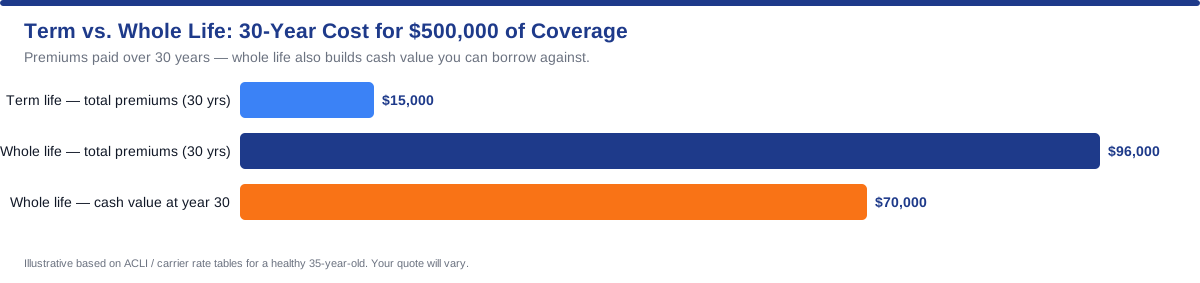
How Term Life Insurance Works
Term life is the simplest product in insurance. You pick a length — typically 10, 15, 20, or 30 years — and a death benefit, say $500,000. If you die during the term, your beneficiaries receive the $500,000. If you outlive the term, the coverage ends and you get nothing back. That sounds harsh, but it is exactly why term is cheap: the insurer is betting you will live, and the math works in your favor most of the time.
Because term has no savings component, every dollar of premium buys pure protection. A healthy 35-year-old can often buy a 20-year, $500,000 term policy for roughly $25 to $35 a month. That is less than many people spend on streaming subscriptions. The catch is that premiums rise sharply if you buy a new term policy later in life, because risk goes up with age and health problems become more likely.
How Whole Life Insurance Works
Whole life bundles two things into one product: a permanent death benefit (it pays whenever you die, at age 90 or 9) and a cash-value account that grows at a rate set by the insurer. Part of every premium funds the death benefit and part feeds the cash value, which you can borrow against or withdraw later. The policy stays in force as long as you pay premiums, and the cash value grows on a guaranteed schedule plus potential dividends.
The permanent protection and savings feature come at a steep price. That same 35-year-old might pay $300 to $400 a month for a $500,000 whole life policy — roughly ten times the term premium. Over 30 years, the total premiums can approach six figures, while the cash value at year 30 might be around $70,000 on a $96,000 paid-in basis — a modest, tax-favored return, but one you could likely beat in a plain investment account if you had the discipline.
The 30-Year Cost Difference
The chart above makes the gap obvious. For $500,000 of coverage over 30 years, term premiums might total about $15,000, while whole life premiums total roughly $96,000. The whole life policy does build back about $70,000 of cash value, but you have still spent ~$26,000 more than term for the privilege — and that is before considering what the $280-a-month difference could have earned if invested elsewhere.
This is not an argument that whole life is a scam. It is an argument that you should know exactly what you are paying for. Whole life is a legitimate estate-planning and tax-favored savings vehicle for people who have already maxed out other tax-advantaged accounts and want permanent coverage. For the average family trying to replace income while the kids are young, term is almost always the rational default.
When Term Life Is the Better Choice
- You have dependents and a finite need. If your goal is to replace income until the kids are independent or the mortgage is paid, a 20- or 30-year term matches the timeline perfectly.
- You want the most coverage per dollar. Term buys the largest death benefit for the lowest premium, freeing cash for retirement and college savings.
- You are healthy and young. Locking in low rates now protects you if your health changes later.
- You have a business or loan to cover. A term policy can be timed to a partnership agreement or a loan payoff schedule.
When Whole Life Can Make Sense
- You need permanent coverage. Someone with a lifelong dependent (a child with special needs) or a large estate that will owe taxes may want coverage that never expires.
- You have maxed out other tax-advantaged accounts. The cash value grows tax-deferred and withdrawals up to basis are tax-free; it can be a fourth bucket after 401(k), IRA, and HSA.
- You want guaranteed, forced savings. If you will not invest on your own, the structure of whole life enforces discipline — at a real cost.
- You are in a high estate-tax bracket. Irrevocable life insurance trusts funded by permanent policies are a classic estate-planning tool.
The "Buy Term and Invest the Difference" Strategy
The most common rational approach is to buy term for the years you actually need it, and invest the premium difference you would have paid for whole life. Mathematically, the invested difference usually grows to more than the whole life cash value — and you keep full liquidity. The catch is behavioral: the strategy only works if you actually invest the difference rather than spending it. Whole life removes that temptation by making the savings automatic and penalty-laden to access.
A practical compromise many families use: carry a large term policy for the dependent years, and own a small whole life policy (enough to cover final expenses) for permanent peace of mind. That delivers the death benefit you need at a fraction of the all-whole-life cost.
Side-by-Side Comparison
| Feature | Term Life | Whole Life |
|---|---|---|
| Coverage period | 10–30 years | Lifetime |
| Monthly cost ($500K, age 35) | ~$25–$35 | ~$300–$400 |
| Cash value | None | Yes, grows guaranteed |
| Best for | Income replacement | Estate & permanent needs |
| 30-yr cost (illustrative) | ~$15,000 | ~$96,000 |
Common Myths
- "Term is wasted money if you live." You are not "wasting" it any more than you waste fire insurance when your house doesn't burn. You bought peace of mind for the risky years.
- "Whole life is the only thing that pays out." Term pays exactly when most deaths occur — while families are young and exposed. That is the point.
- "I'll convert later." Many term policies are convertible, but the conversion price locks in at your original (higher) age — often expensive. Decide based on need, not a vague plan to switch.
A Quick Decision Checklist
- Do you have dependents who rely on your income? Yes → term is almost certainly your core need.
- Will anyone rely on you permanently (special-needs child, estate tax)? Yes → add a whole life or permanent layer.
- Have you maxed your 401(k), IRA, and HSA? No → invest the difference yourself instead of buying whole life.
- Can you comfortably afford the premium for 30 years? If whole life stretches your budget, it can lapse and you lose the biggest benefit — the death protection.
A Worked Example: $500,000 for a 35-Year-Old
Consider a healthy 35-year-old parent of two earning $70,000. A 20-year, $500,000 term policy might run about $28 a month — roughly $6,700 over the term, money that buys $500,000 of protection for the exact years the children are dependent and the mortgage is outstanding. The same person buying whole life at $340 a month pays about $81,600 over those 20 years, accumulating perhaps $45,000 of cash value by year 20. The term buyer who invests the $312 monthly difference at a 6% return would accumulate roughly $140,000 by year 20 — far more than the whole life cash value — while still holding the full $500,000 of protection. The whole life buyer gains guaranteed lifetime coverage and forced savings, but pays a large premium for both. Neither choice is "wrong"; the point is to decide with the numbers in front of you rather than the sales pitch.
What Happens If Your Health Changes?
The quiet risk with term is that if you develop a serious condition mid-term, renewing or buying new coverage later can become unaffordable or impossible. That is why convertible and guaranteed-renewable features matter: a convertible term policy lets you switch to permanent coverage without a new medical exam, locking in insurability while you are still healthy. If you suspect you might need permanent coverage later — say, a family history of needing long-term care or a special-needs dependent — choose a term policy with a strong conversion option rather than the cheapest bare term. The small premium difference buys optionality that can be worth more than the cash value of a whole life policy you bought too early.
Related Articles
How Much Life Insurance Do You Need?
The DIME method and term vs. whole trade-offs
Do You Need Umbrella Insurance?
When extra liability protection pays off
Health Insurance Subsidies
ACA premium tax credits explained
How to Choose an Insurer
Financial strength, complaints, service
Explore State Guides
New York Insurance
Local rates & requirements
California Insurance
Local rates & requirements
Texas Insurance
Local rates & requirements
Frequently Asked Questions
No. Term life is priced so the insurer expects most policyholders to outlive it — that is what makes it affordable. You are buying protection for the years your family is most financially exposed, the same way you carry car insurance without hoping to crash. The "waste" framing ignores that the benefit bought peace of mind and income protection during the risky decades.
Many term policies include a conversion rider that lets you exchange the term policy for a permanent one without a new medical exam, usually before a set age (often 65–70). The catch is that the new premium is based on your original issue age, which by then is high, so the converted policy is expensive. Treat conversion as a safety net, not a plan.
Whole life charges you for two things at once: lifelong death protection and a cash-value savings account the insurer manages and guarantees. The savings component carries operating costs, commissions, and a guaranteed return the company must fund. Term charges only for temporary protection, so nearly all of your premium buys coverage.
Unless you bought an optional rider, the cash value generally stays with the insurer and your beneficiaries receive only the death benefit. If you cancel (surrender) the policy while alive, you get the cash value minus any surrender charges. That is why borrowing against the cash value is often preferred over surrendering — it keeps the death benefit in place.
For most people, no — not first. The investing return inside whole life is conservative and the fees are high. The sensible order is: build an emergency fund, max out employer retirement matches and tax-advantaged accounts, then consider whole life only if you still have a permanent-coverage need and want the tax-favored, forced-savings features. High earners with estate concerns are the usual fit.
A common starting point is 10–12 times your annual income, or the amount that replaces your income until dependents are independent and the mortgage is paid. Use our life insurance calculator for a personalized estimate based on your debts, income, and goals.
Related Tools
Life Insurance Calculator
Estimate your life insurance cost
Health Insurance Calculator
Estimate marketplace premiums
Umbrella Insurance Calculator
Estimate extra liability cost
Data sources: American Council of Life Insurers (ACLI), Insurance Information Institute (III). Last updated: July 2026. This article is original editorial content for educational purposes and does not constitute insurance advice; consult a licensed agent for decisions specific to your situation.