Picking a health plan is less about the premium and more about the trade-off between that premium and everything else: the network of doctors you can use, the deductible you pay before insurance kicks in, and the maximum you could owe in a catastrophic year. The four main structures — HMO, PPO, EPO, and HDHP with an HSA — each strike that balance differently. Understanding the acronyms before open enrollment saves both money and frustration when you actually need care.
Estimate Your Health Premium
See how plan type changes your monthly and annual cost.
Open the Health Insurance Calculator →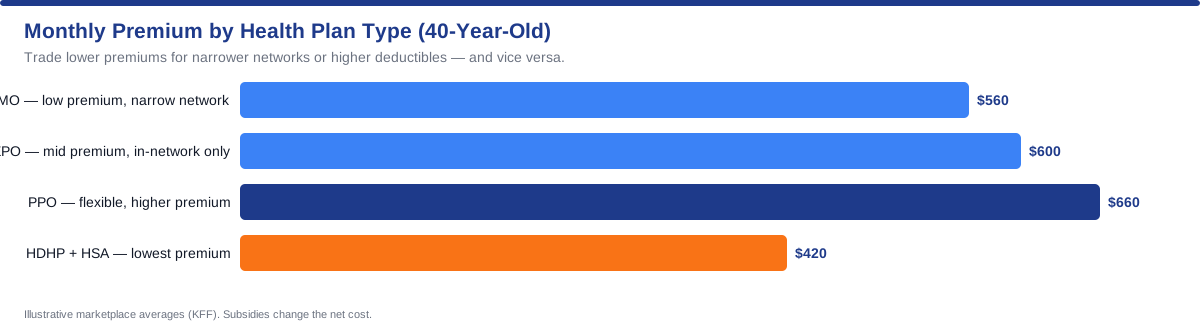
HMO — Health Maintenance Organization
An HMO uses a tight network of doctors and hospitals. You choose a primary care physician (PCP) who coordinates your care and provides referrals to see specialists. Out-of-network care is generally not covered except in emergencies. The payoff is the lowest premiums and often the lowest cost-sharing — but the least freedom. HMOs suit people who have a trusted in-network PCP and rarely need out-of-network specialists.
PPO — Preferred Provider Organization
A PPO gives you a network with discounted rates but lets you see any provider, in or out of network, without a referral. You pay less in-network and more out-of-network, but the door is open. Premiums are usually the highest of the four types. PPOs fit people who want a specific doctor or specialist outside a narrow network, or who travel frequently and value flexibility.
EPO — Exclusive Provider Organization
An EPO is the middle child: like an HMO, it covers only in-network care (no out-of-network except emergencies) and usually needs no referrals. But it often has a somewhat broader network than a comparable HMO and a lower premium than a PPO. It is a good compromise if you want PPO-like simplicity without paying PPO prices, and you are comfortable staying in-network.
HDHP + HSA — High-Deductible Health Plan with a Health Savings Account
An HDHP pairs a high deductible (often $1,500+ individual, $3,000+ family) with a tax-advantaged HSA you fund yourself. Premiums are the lowest, but you pay most routine care out of pocket until the deductible is met. The HSA is the magic: contributions are tax-deductible, grow tax-free, and can be invested — a triple tax benefit. HDHPs suit healthy people who can fund the HSA and want to build a medical nest egg, and anyone who likes the investment angle.
The Real Trade-off: Premium vs. Risk
Low-premium plans (HDHP, some EPOs) shift risk to you — a bad year means a big deductible hit, cushioned only by your HSA. High-premium plans (PPO, rich HMOs) pre-pay that risk into the monthly bill, so a bad year costs you little beyond copays. The right choice depends on your health volatility and cash buffer: a chronic condition or a young family probably wants lower risk (higher premium); a healthy single person can often save by taking the HDHP and banking the difference in an HSA.
Out-of-Pocket Maximums Matter Most
Every ACA-compliant plan caps your annual spending through the out-of-pocket maximum (around $9,200 individual / $18,400 family for 2026, indexed annually). After you hit it, the plan pays 100%. When comparing plans, the deductible tells you the early pain; the out-of-pocket max tells you the worst-case ceiling. A plan with a low deductible but a high max may still expose you more in a catastrophe than a high-deductible plan with a lower max.
Comparing the Four Types
| Plan type | Network freedom | Referral needed? | Typical premium |
|---|---|---|---|
| HMO | Low (in-network) | Yes | Lowest |
| EPO | Low–mid | No | Low–mid |
| PPO | High | No | Highest |
| HDHP + HSA | Varies (often PPO net) | No | Lowest |
How Subsidies Change the Math
If you buy on the ACA marketplace and your income falls below certain thresholds, premium tax credits cap what you pay as a percentage of income (see our subsidies guide). Subsidies can make a richer PPO cheaper than an unsubsidized HDHP — so always price the subsidized net cost, not the sticker premium. Cost-sharing reductions (CSR) on Silver plans further lower deductibles and max out-of-pocket for lower incomes.
A Decision Shortcut
- Want the cheapest monthly bill and a medical savings habit? HDHP + HSA, and fund it.
- Have a trusted in-network doctor and few specialist needs? HMO.
- Want in-network savings without referral hassle? EPO.
- Need a specific out-of-network specialist or travel a lot? PPO.
- Buying on the marketplace with subsidies? Compare the net (subsidized) premium across all four before deciding.
Prescription Drugs and Formularies
No plan comparison is complete without the drug formulary — the list of covered medications and their tier (generic, preferred brand, non-preferred, specialty). Two plans with identical premiums can differ enormously in what you pay for the same prescription. If you take regular medication, check that it is on the formulary and at what tier before you choose; a plan that covers your drug at tier 1 can beat a cheaper-premium plan that puts it at tier 3 or excludes it. This single check often matters more than the network type.
Switching Plan Types at Renewal
You are not locked into an HMO forever. During each open-enrollment period you can switch to a PPO, EPO, or HDHP if your needs changed — a new diagnosis, a different doctor, a new baby. The catch is that pre-existing conditions are covered (thanks to ACA protections) but your deductible resets, and any in-progress care may need re-authorization with a new network. Plan switches are best made with a full year of claims in view, so you choose based on actual usage rather than guesswork.
Don't Confuse "Premium" With "Total Cost"
The premium is the visible number, but your real cost is premium plus expected out-of-pocket. A $200/month PPO that covers your $10,000 surgery with a $500 copay may cost less in a bad year than a $50/month HDHP where you pay $6,000 of that surgery before the plan kicks in. Always model a typical year (routine visits + one plausible bad event) for each plan type, then compare totals — not just the monthly sticker. Subsidies further distort this, so price the net premium after credits.
The HDHP + HSA Investment Angle
The reason many financial planners love the HDHP + HSA combo is the triple tax advantage: contributions are tax-deductible (or pre-tax through payroll), growth is tax-free, and withdrawals for qualified medical expenses are tax-free. After age 65 you can even withdraw for any purpose and only pay ordinary income tax — effectively a second retirement account. For a healthy person who funds the HSA annually and invests it, the account can grow to six figures over a career, covering both routine care and retirement medical costs. That long-term benefit often outweighs the short-term convenience of a low-deductible plan, provided you can afford the higher upfront risk.
Catastrophic Plans for the Young and Healthy
There is one more type worth knowing: the catastrophic plan, available to people under 30 (and to older buyers with a hardship exemption). It has a very high deductible and low premium, covering only preventive care plus three primary-care visits before the deductible, then 100% after the out-of-pocket max. It is pure protection against a ruinous event, with no routine care coverage — ideal for a healthy 25-year-old with an emergency fund, and a reminder that "plan type" is really a spectrum from comprehensive to catastrophe, not just four boxes.
Related Articles
Health Insurance Subsidies
ACA premium tax credits
Term vs. Whole Life
Protect your family's health
How Much Life Insurance
DIME and human-life-value
How to Choose an Insurer
Complaints & service
Explore State Guides
California Insurance
Local rates & requirements
New York Insurance
Local rates & requirements
Texas Insurance
Local rates & requirements
Frequently Asked Questions
An HMO restricts you to a network and requires a primary care referral to see specialists, in exchange for the lowest premiums. A PPO lets you see any provider without a referral and covers out-of-network care at a higher cost, in exchange for the highest premiums. EPOs sit between them — in-network only, no referrals.
Often not as a first choice. A chronic condition means you will hit the deductible most years, so you trade a low premium for high predictable out-of-pocket costs. A richer PPO or HMO may cost more monthly but cap your spending sooner. The exception is if you can fully fund an HSA and invest it — but for active treatment, lower cost-sharing usually wins.
It is the most you pay in a plan year for in-network covered care; after you reach it, the plan pays 100%. For 2026 it is around $9,200 individual / $18,400 family (indexed). It is your catastrophe ceiling — often more telling than the deductible when comparing plans, because it caps your worst-case exposure.
No — only with a qualified high-deductible health plan (HDHP). You cannot contribute to an HSA while covered by a non-HDHP health plan (with narrow exceptions like certain limited-purpose FSAs). If you have an FSA through work, that can also disqualify HSA contributions, so coordinate the two.
Premium tax credits apply to any metal-tier marketplace plan (Bronze through Platinum), regardless of network type. Cost-sharing reductions only apply to Silver plans. Always compare the subsidized net premium across HMO/EPO/PPO/HDHP options, because a subsidy can flip which is cheapest.
Usually an HDHP + HSA. You pay the lowest premium and can bank the HSA savings tax-free for future care or retirement. If you want a little more predictability for occasional visits, a low-cost EPO or HMO with a modest copay structure is a reasonable alternative — just compare total expected cost, not just the premium.
Related Tools
Health Insurance Calculator
Estimate marketplace premiums
Life Insurance Calculator
Estimate your life insurance cost
Umbrella Insurance Calculator
Estimate extra liability cost
Data sources: KFF, HealthCare.gov. Last updated: July 2026. This article is original editorial content for educational purposes and does not constitute insurance advice; consult a licensed agent for decisions specific to your situation.